
Online doctor, Morocco
Food Poisoning in Morocco Start with the meal you can name.
Sick within hours of eating, and you have a fair idea which meal did it? NHS guidance says food poisoning usually starts within a few hours or days of eating something and usually settles within a week, so a suspect plate a few hours ago is worth taking seriously as information. Speak with an English-speaking doctor by video, licensed to treat you in Morocco, for a fixed €40, and get a clear answer on whether this is one to manage where you are.
When it started, what you ate, whether there was ice in the glass, and who else at the table is ill. Those four answers are most of what a doctor needs, and you already have them.
- €40
- per consultation
- No insurance
- or local registration needed
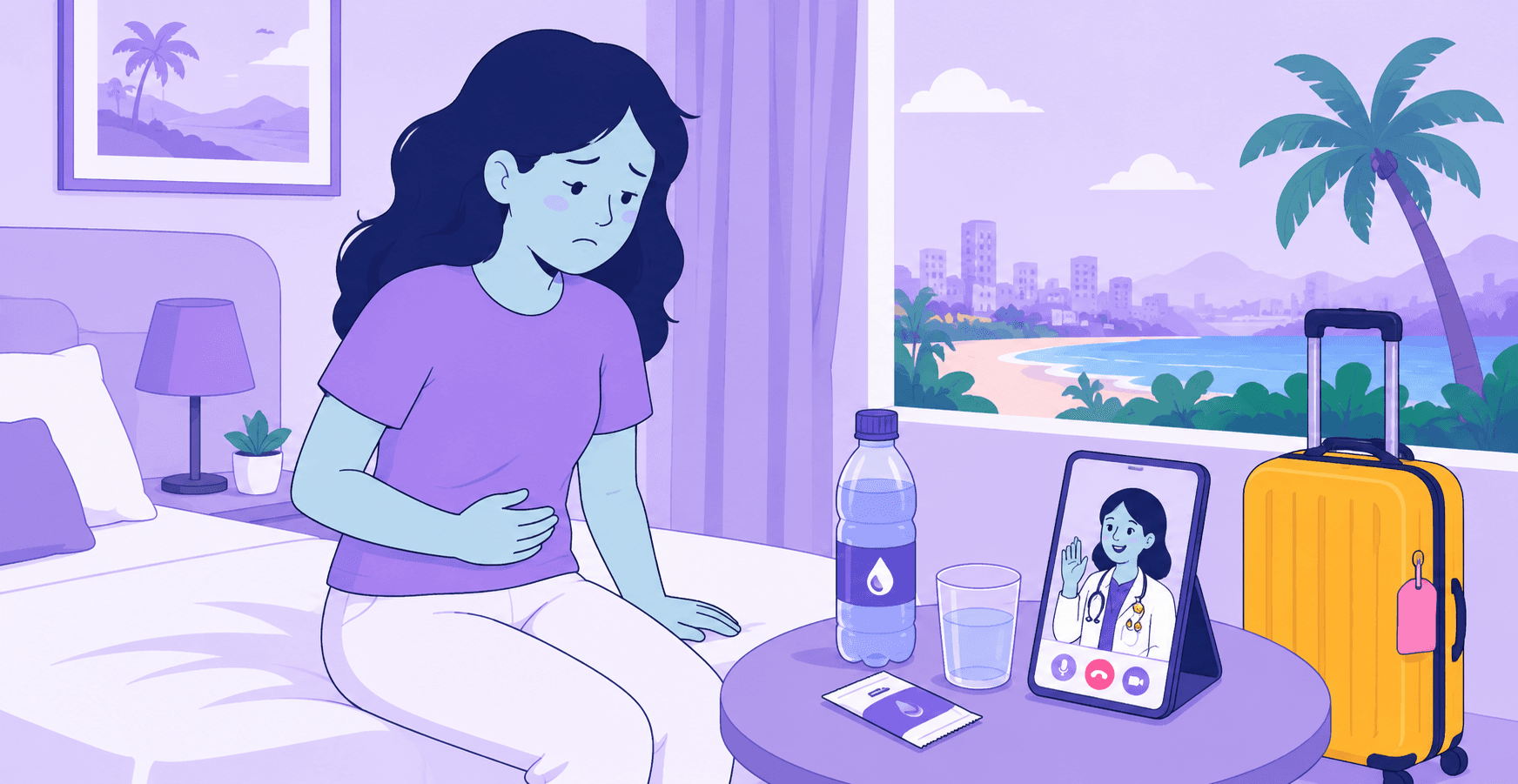
English-speaking doctors, licensed to treat you in Morocco.
When You Can Point at the Plate
NHS guidance describes food poisoning as feeling sick or being sick, diarrhoea, stomach pain, a high temperature and feeling generally unwell, usually beginning within a few hours or days of eating something and usually settling within a week. That window is the most useful thing you own: it is what separates a meal worth mentioning from a meal you have simply remembered.
Morocco adds two things to the picture. NaTHNaC's advice for the country is that all travellers should take care with personal, food and water hygiene, and it recommends hepatitis A vaccination for every previously unvaccinated traveller and typhoid vaccination for most — both infections that travel by contaminated food and water, which is the same route a bad meal takes. Neither is the likely answer, and both are worth a doctor knowing about.
With Pomodoc you can talk it through by video from your riad, hotel or guesthouse: what you ate, when it started, what you are keeping down, and whether this needs anything more than the next twenty-four hours.
- Consult securely by video
- Avoid unnecessary travel and waiting rooms
- Get clear guidance about your symptoms and treatment
- Access care while travelling or living in Morocco
Work Out What Did It, or Get Seen?
A meal that has made you ill raises two separate questions: what to do about your symptoms, and what to say to the kitchen that served it. The first one comes first, and it is the one a doctor can help with.
A video consultation is a useful first step when
- you can name a meal and want to know whether the timing actually fits
- you are keeping some fluids down but cannot judge whether it is enough
- you were not vaccinated before the trip, or cannot remember, and want that factored in
- you are on a tour and need to decide tonight whether to carry on tomorrow
- you want a set of thresholds for the night, so waiting is a decision rather than a hope
For an ordinary case the honest output is a plan and a set of warning signs, not a prescription. Telling the property is worth doing early and separately — not as a complaint, but because a kitchen that knows several guests are ill can act, and because your own note of what you ate and when it started is useful to a doctor afterwards. Anything past that is not a medical question and this page does not advise on it.
Go to a clinic, or call 150, instead when
- you cannot keep any fluids down at all, or there are signs of dehydration
- there is blood or mucus in the stool, or a fever of 38°C or more
- there is severe abdominal pain, jaundice, a rash, or confusion or drowsiness
- the person affected is a baby, a young child, an older traveller, or someone with a long-term condition
- the illness followed a drink rather than a meal and there is confusion or trouble seeing
Pomodoc connects you with an English-speaking doctor by video, licensed to treat you in Morocco, for €40 per consultation. Fixed price, no surprises.
If you need to be examined, you will be told to go, and being told early is worth more here than almost anywhere: outside the cities the drive to a clinic is measured in hours rather than minutes.
Your consultation runs on Air Doctor's ISO‑certified platform (ISO/IEC 27001 & ISO 27799 for health data). See our security & certifications.
How It Works
Medical advice by video in three simple steps
Start online
Tell us that you are in Morocco and what you ate. It is a short form, not an appointment request.
Join by video
See your English-speaking doctor using your phone, tablet or computer.
Get clear guidance
Discuss your symptoms and receive advice about your next steps.
Why Use Pomodoc?
Explain it in English
Describe the meal and your symptoms in English, rather than assembling the words for it at a counter in French first.
The history is most of the assessment
What you ate, when it started and who else is ill are things you can say down a video call as well as you could say them in a waiting room.
Decide before the drive
In Marrakech a clinic is a taxi away. In the Atlas or the desert it is most of a day. Knowing whether you need one is worth having before you commit to finding out.
Understand what to do next
A doctor can help you decide whether you need treatment, rehydration support or an in-person appointment.
Travellers who needed a doctor abroad
I was very happy to find this service
I was very happy to find this service! I was able to get a video visit with a physician promptly and get care.
Easy, competent, nice
Doctor was very nice and adequately thorough, explained everything very well. The whole process was far easier than expected.
Reliable and efficient
Reliable and efficient, able to provide medical support while you're away from home.
Reviews of Air Doctor, our medical partner, published on Trustpilot.
More About Food Poisoning in Morocco
The timing is your first piece of evidence
NHS guidance puts the start of food poisoning within a few hours or days of eating something, and settling usually within a week. That is why last night's dinner is worth naming and last Tuesday's usually is not, and it is the single most useful thing to have ready before a consultation.
It does not prove anything on its own. A bug picked up from a surface, a door handle or another person can look identical from the inside, and the honest answer to what did it is often that nobody can be certain without testing. The point of the timing is not certainty; it is narrowing the field enough for a doctor to work with.
What actually did it, in Moroccan form
NaTHNaC's list of what to avoid is generic and worth reading in its local form. It names food left uncovered in warm environments, salads and uncooked fruit and vegetables, unpasteurised dairy, and raw or undercooked meat, fish or shellfish, and it names ice as something to avoid where sanitation is poor. It puts recently prepared, thoroughly cooked food served piping hot in the safer column, along with fruit you peel yourself.
In Morocco those categories have faces. A tagine that came off the heat at noon and was kept warm for the afternoon is the first item on the list, not the last. Raw salad and unpeeled fruit are the second. Lben and raib, the fermented milk drinks, are the third if they were not pasteurised. And ice is the one nobody counts as eating: in a glass of mint tea, in a fresh-pressed orange juice at a stall, or in the water at the basin when you brushed your teeth.
None of this is an argument against Moroccan food, and a busy grill where the food goes from flame to plate in front of you is squarely in NaTHNaC's safer column. The pattern behind most holiday stomach upsets is not the street; it is food that was cooked properly and then stood in a warm room.
Two infections travel the same route as a bad meal
This is the part that is specific to Morocco. NaTHNaC recommends hepatitis A vaccination for all previously unvaccinated travellers to Morocco, and typhoid vaccination for most travellers — particularly those visiting friends and relatives, young children, and frequent or long-stay travellers going to areas where sanitation and food hygiene are likely to be poor. Both infections are transmitted through contaminated food and water.
That does not make either the likely explanation for feeling unwell after dinner, and it should not be read that way. What it does is change one question at the start of a consultation from small talk into information: whether you were vaccinated before you travelled. If you were, a doctor can set both aside. If you were not, or cannot remember, it is a thing worth saying out loud rather than something to look up afterwards.
If your itinerary keeps moving
The classic Moroccan trip is not static. A desert tour, an Atlas circuit or a run down the coast means the answer to how far away a clinic is changes by the hour, and away from the main cities a hospital may be a long drive away. Getting a plan and a set of warning signs while you still have signal is worth more on that kind of trip than on a week in one riad.
It also changes the practical question a doctor can help with, which is usually not treatment but whether to carry on. Continuing a mountain road with a stomach that will not hold water is a different proposition from continuing it while recovering, and that is a judgement rather than a rule.
If the answer turns out to be a pharmacy, Morocco makes that easy: our travellers' diarrhoea page covers the 24-hour pharmacies and how to rehydrate, and does not need repeating here.
Words for the meal, and for the front desk
| In French | What it means |
|---|---|
| Je crois que c'est la nourriture | I think it was the food |
| J'ai mangé ici hier soir | I ate here last night |
| Nous sommes plusieurs à être malades | Several of us are ill |
| des crudités | raw vegetables, salad |
| des glaçons | ice cubes |
| du lait non pasteurisé | unpasteurised milk |
| Un médecin, s'il vous plaît | A doctor, please |
French is the working language of riads, hotels and clinics in the cities. These are the phrases for telling a property what happened, rather than for the pharmacy counter — those are on our travellers' diarrhoea page for Morocco.
Good things to know.
Was it the tagine, the salad or the water?
Nobody can tell you for certain without testing, and a doctor will not pretend otherwise. What moves it past a hunch is the pattern: symptoms starting within hours rather than days, other people who ate the same dish going down at the same time, and a plausible source. NaTHNaC's list puts food left uncovered in warm environments, raw salad and uncooked vegetables, unpasteurised dairy, and ice where sanitation is poor in the column to avoid — which in practice means a tagine kept warm all afternoon is a more likely answer than the grill that cooked in front of you.
Is this food poisoning, or a stomach bug I picked up?
From the inside they can look the same, and the treatment for an ordinary case of either is rest and fluids. The difference that matters is the timing and the company: a meal a few hours ago that several of you shared points one way, and days of gradual upset with no suspect meal points the other. If you cannot name a meal, our travellers' diarrhoea page for Morocco is the one written for you — it covers duration, rehydration and when to stop waiting.
Could this be hepatitis A or typhoid?
Both are transmitted through contaminated food and water, and NaTHNaC recommends hepatitis A vaccination for all previously unvaccinated travellers to Morocco and typhoid vaccination for most travellers. That makes them worth mentioning, not worth assuming: the overwhelming majority of holiday stomach upsets are neither. The useful thing is to know whether you were vaccinated before you travelled and to say so at the start of a consultation, because it changes what a doctor considers.
Several of us ate the same thing and we are all ill. What now?
Judge each person separately against the warning signs rather than treating it as one case, because dehydration does not arrive at the same speed in everybody — a child, an older traveller or anyone with a long-term condition can need help sooner than the rest of the group. Tell the property early so the kitchen can act. Then work through the thresholds above for each person, which is exactly the conversation a single consultation can cover.
I am on a desert or Atlas tour. Does that change anything?
It changes the logistics rather than the medicine. The thresholds are the same, but away from the main cities a hospital may be a long drive away, so the cost of getting the decision wrong is higher and the value of deciding early is greater. Speak to someone while you have signal, get the warning signs, and tell your guide or driver what they are — that is more useful than deciding at 3am on a mountain road.
Should I tell the riad or the tour operator?
Yes, early, and separately from anything you decide about your own care. A kitchen that knows two or three guests are ill can act on it, which is worth something to the people who eat there tomorrow. Keep your own note of what you ate and when it started, because it is useful to a doctor later. What you do beyond that is not a medical question and this page does not advise on it.
How much does a Pomodoc video consultation cost?
€40 is the fixed price of the video consultation with a doctor. It includes the consultation and, where clinically appropriate and local rules permit, a prescription. Medication you buy at a pharmacy, and any in-person care you go on to need, are separate. There is no subscription and no booking fee.
When is a video consultation not the right call?
Not when NaTHNaC's immediate-care signs are present — a fever of 38°C or more, blood or mucus in the stools, severe abdominal pain, jaundice or a rash — and not when you cannot keep any fluids down or show signs of dehydration. Not for a baby under twelve months. And not when the illness followed a drink and there is confusion, drowsiness or trouble seeing: FCDO reports methanol in alcoholic drinks in Morocco, and that is an emergency. In Morocco call 150 for an ambulance. It is also not the right tool when a doctor needs to examine you or run a test — and if that is what your symptoms need, being told so early is the useful outcome of the call.
Sources
- Food poisoningNHSThe symptom list; that it usually starts within a few hours or days of eating something and usually settles within a week; the reasons to seek advice including dehydration, being unable to keep fluids down, diarrhoea beyond seven days, vomiting beyond two days and babies under twelve months; and the emergency symptoms, including vomiting blood, vomit that looks green or yellow-green, severe stomach pain, a sudden severe headache, a stiff neck with pain on looking at bright lights, skin, lips or tongue that look blue, grey, pale or blotchy, severe difficulty breathing, being confused or not responding as usual, and possibly having swallowed something poisonous.
- Morocco: country informationNaTHNaC (TravelHealthPro)That all travellers to Morocco should take care with personal, food and water hygiene; that hepatitis A is transmitted through contaminated food and water and vaccination is recommended for all previously unvaccinated travellers; and that typhoid is transmitted through contaminated food and water and vaccination is recommended for most travellers, particularly those visiting friends and relatives, young children, and frequent or long-stay travellers visiting areas where sanitation and food hygiene are likely to be poor.
- Food and water hygieneNaTHNaC (TravelHealthPro)The safer food options of recently prepared, thoroughly cooked food served piping hot and fruit the traveller can peel; the foods to avoid including salads, uncooked fruit and vegetables, food left uncovered in warm environments, unpasteurised dairy and raw or undercooked meat, fish or shellfish; that where sanitation is poor tap water should not be drunk or used to brush teeth unless treated, and ice should be avoided; that medical care should be sought if diarrhoea does not improve within three days; and that immediate care should be sought for a fever of 38°C or more, blood or mucus in the stools, severe abdominal pain, jaundice or rash.
- Morocco travel advice: HealthForeign, Commonwealth and Development Office150 for an ambulance; that public health facilities provide limited medical care and that private clinics are available and operate to a higher standard (re-checked 2026-10-01); and the advice on travel health insurance and accessible funds.
- Morocco travel advice: Safety and securityForeign, Commonwealth and Development OfficeThe reports of deaths and serious illness from alcoholic drinks containing methanol in Morocco, that methanol cannot be identified by taste or smell, and the advice to seek urgent medical attention for signs of methanol poisoning.
Sources last checked: . General information, not a diagnosis.

Not Sure Whether You Need a Doctor?
Speak to an English-speaking doctor by video and get guidance from wherever you are staying in Morocco.
- €40, fixed price
- Licensed in Morocco
- English-speaking doctors
- Prescriptions where available
Video consultations are for suitable non-emergency medical concerns. In a life-threatening emergency in Morocco, call 150 and ask for an ambulance, or go to the nearest emergency department. This page is general information, not medical advice about your own situation.