
Online doctor, India
See an Online Doctor in India By video, from your room.
Finding a doctor is not the hard part in India. Working out which of the many options you should be using, at 11pm, in a city you do not know, with no idea what it will cost — that is the hard part. Pomodoc connects you by video with a doctor licensed to treat you in India, for a fixed €40, so you can find out what you are dealing with before you decide where to go. In a medical emergency, FCDO's number for an ambulance is 112.
English is not the only question here: FCDO publishes a list of medical providers in India where some staff speak English. Knowing which door to use, and what it will cost, is the problem.
- €40
- per consultation
- No insurance
- or local registration needed
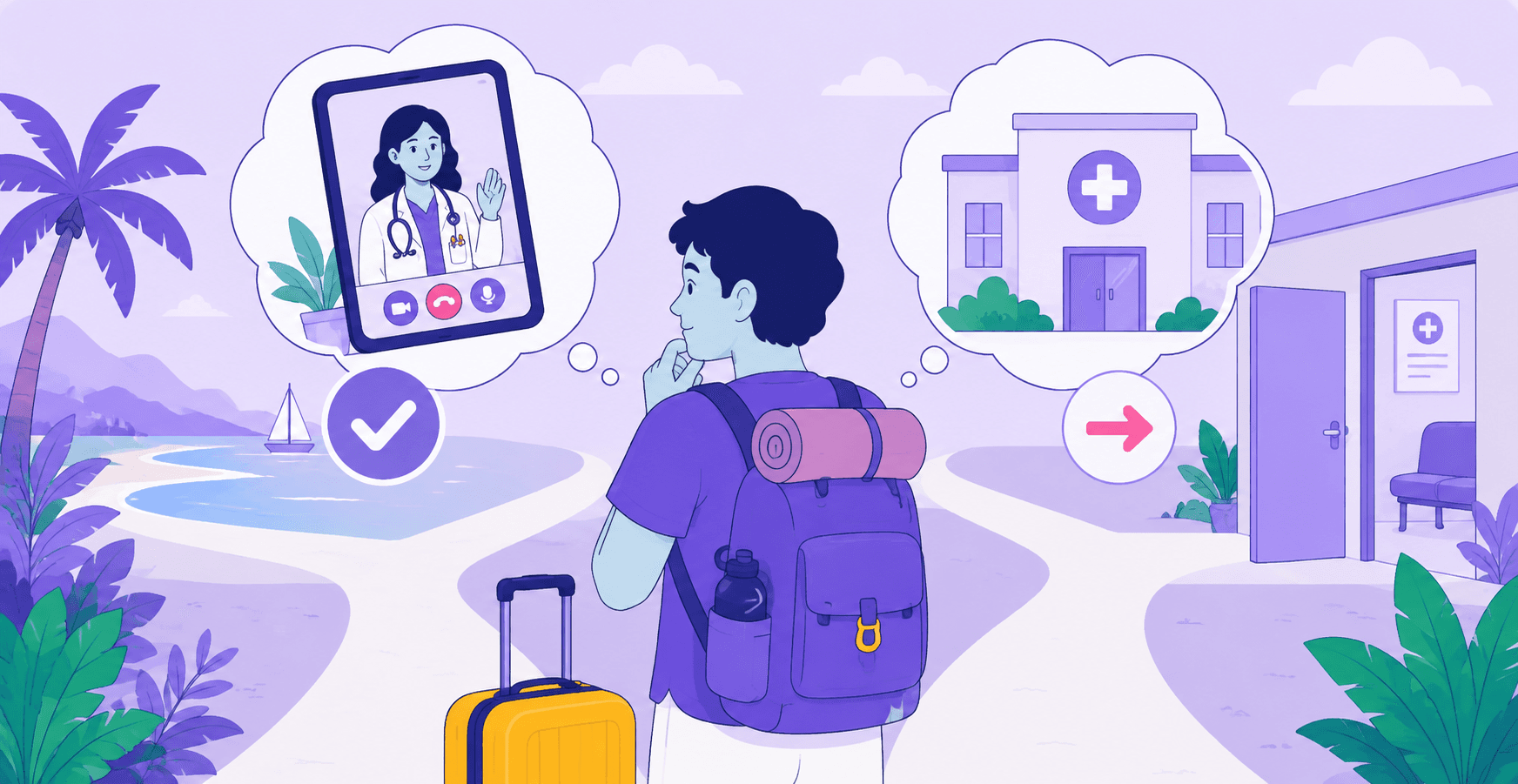
Video consultations with doctors licensed to treat you in India, in English.
Online Medical Advice in India, Before You Choose a Hospital
India is not a country where care is hard to find. It is a country where a visitor has too many options and no default: government hospitals, private hospitals of every size, standalone clinics and pharmacies. FCDO's summary is that medical facilities differ from those in the UK, especially in more remote areas, and that in major cities government and more expensive private medical care is available.
That is a reasonable description and it is not a decision. Deciding is what a consultation is for: a doctor can hear what is actually happening, tell you whether this needs an examination at all, and if it does, what kind of place you should be looking for.
With Pomodoc you speak with a doctor by video wherever you are — Delhi, Goa, Kerala, a homestay in Rajasthan — for a fixed €40, with no insurer, no policy number and no local registration involved.
- Consult securely by video
- Avoid unnecessary travel and waiting rooms
- Get clear guidance about your symptoms and treatment
- Find out whether in-person care may be needed
Walk In, Go Private, or Start With a Video Call?
All three are real options in an Indian city, and the honest answer depends on how unwell you are — which is the thing you cannot judge from inside it.
What is available around you
- private hospital outpatient departments (OPDs), for anything that needs examining
- government hospitals, which FCDO notes are available in major cities alongside more expensive private care
- pharmacies, which are widely available — though FCDO says most medicines needing a UK prescription need one in India too
- 112 for an ambulance, which is the number FCDO gives
This is a genuinely well-served country for anyone who needs to be examined, and we are not going to pretend an OPD visit is a bad option — for a lot of problems it is the right one. What it costs you is a journey across a city you do not know and a wait, for a question that may not need either.
What a video consultation adds
- an answer on whether you need an OPD at all, before you spend an evening finding out
- somewhere to start at the hours when crossing an unfamiliar city is the worst part
- a fixed €40, against a private bill you cannot see in advance
- a plan for a moving itinerary, when tomorrow is a train rather than the same hotel
Pomodoc connects you with a doctor by video, licensed to treat you in India, for €40 per consultation. Fixed price, no surprises.
If you need to be seen, you will be told to go, and told what to look for. That is a better use of a first conversation than guessing which of four hospitals on a map is the right one.
Your consultation runs on Air Doctor's ISO‑certified platform (ISO/IEC 27001 & ISO 27799 for health data). See our security & certifications.
How It Works
An online consultation by video, in three simple steps
Start online
Tell us where you are in India and what is going on. It is a short form, not an appointment request.
Join by video
See your doctor using your phone, tablet or computer.
Get clear guidance
Discuss your symptoms and receive advice about your next steps.
Why Use a Video Doctor?
Decide before you travel across a city
The cost of an OPD visit is not the fee. It is the evening, the traffic and the wait, for a question that might be answered in ten minutes.
A price you can see first
€40, fixed, whatever you turn out to have. FCDO advises holding insurance for local treatment and evacuation, and a consultation is not that — it is the small, known cost at the front of it.
Useful when the itinerary keeps moving
Overnight trains, internal flights and a different city every three days change the question from what is wrong to whether you should get on the train. That is worth asking someone.
Understand what to do next
A doctor can help you decide whether you need treatment, an examination or simply a day of rest and fluids.
Travellers who needed a doctor abroad
I was very happy to find this service
I was very happy to find this service! I was able to get a video visit with a physician promptly and get care.
Excellent doctor
Excellent doctor, very professional and friendly and speaks excellent english
Reliable and efficient
Reliable and efficient, able to provide medical support while you're away from home.
Reviews of Air Doctor, our medical partner, published on Trustpilot.
More About Seeing a Doctor in India
What FCDO actually says, and what it leaves to you
FCDO's health advice for India is short and worth reading literally. Medical facilities differ from those in the UK, especially in more remote areas. Specialised treatment may not be available outside major cities. In major cities, government and more expensive private medical care is available. And travellers should have appropriate travel insurance for local treatment or unexpected medical evacuation, which matters most for anyone with an existing condition or who is pregnant.
Notice what that does not do: it does not tell you which to use. That is left to the traveller, and it is the actual decision. FCDO does publish a list of medical providers in India where staff speak English, which is the most useful single link if you already know you need to be seen in person.
Prescriptions: the rule is the same as home, and the blogs suggest otherwise
FCDO is direct: most medicines that require a prescription in the UK will require one in India. That is worth knowing before you arrive at a pharmacy counter expecting to describe a symptom and be handed a course of something, and it is worth knowing before you read a travel blog that names a specific antibiotic.
FCDO's practical advice if you take regular medication is to bring the original packaging, so a pharmacist can see exactly what you need rather than working from a name that may be branded differently in India.
A Pomodoc doctor may issue a prescription where it is clinically appropriate and local rules permit. It is not guaranteed for any consultation, some medicines cannot be prescribed by video at all, and medication you buy is not included in the €40.
The air, and why you might feel unwell without an infection
FCDO names air quality as a health risk in India, particularly between October and February in the northern cities, and singles out children, older travellers and anyone with a respiratory or cardiac condition.
It is on this page because it produces symptoms people reasonably mistake for illness: a cough that will not settle, a sore throat, tight breathing, irritated eyes. Those are also things a doctor can talk through by video, and knowing that the cause is the week's air rather than an infection changes what you do about it — and whether an antibiotic was ever the question.
Anyone whose asthma or heart condition is worse than usual should not be waiting to see how it goes, in Delhi in January or anywhere else.
A stomach upset is the most likely reason you are reading this
It is the commonest travel illness in India, and it is the only one with a nickname that travels further than the illness does. Everybody arrives having heard of Delhi belly and almost nobody arrives knowing what it actually means.
Our Delhi belly page is written for exactly that: what the name actually covers, what the symptoms are, how long it should last, when it stops being something to manage yourself, and whether it is safe to get on tomorrow's train. It also takes apart the antibiotic advice you will find on the travel blogs.
NaTHNaC's general advice for India is that all travellers should take care with personal, food and water hygiene, and it recommends hepatitis A vaccination for all previously unvaccinated travellers and typhoid vaccination for most.
Mosquitoes, and why a fever in India is not one question
NaTHNaC states there is a risk of dengue in India and advises avoiding mosquito bites, particularly during daytime hours when the mosquitoes that carry it are most active. It reported that, as of 13 July 2026, a total of 22,938 dengue cases had been reported in India during 2026, and 108,379 suspected chikungunya cases with 4,995 confirmed as of December 2025.
On malaria the picture is regional: NaTHNaC identifies a risk in the states of Mizoram, Odisha and Tripura where antimalarial medication is recommended, and describes a low risk across the rest of India. FCDO also names Zika among the health risks.
None of that is a reason not to go, and it is not what most fevers turn out to be. It is a reason to say where in India you have been at the start of a consultation, because it changes what a doctor considers — and a reason not to sit on a fever for three days waiting for it to declare itself.
Good things to know.
Can I see an online doctor in India as a visitor?
Yes. Private hospital outpatient departments in the cities are one in-person route, government and private care are both available in major cities according to FCDO. Pomodoc is the other option: a video consultation with a doctor licensed to treat you in India, for a fixed €40, with no insurance or local registration needed.
Can I have an online consultation with a doctor in India?
Yes. A Pomodoc online consultation is a video call, a form of telehealth: you speak with a doctor licensed to treat you in India, in English, from your phone, tablet or computer, for a fixed €40. It suits non-emergency concerns where the decision rests on what you can describe and show on camera. If your symptoms need an examination, a swab or a test, the doctor will tell you so, and where to go.
Do doctors in India speak English?
Widely, yes — English is the working language of Indian medical education and FCDO publishes a list of medical providers where staff speak English. This is one country where we are not going to sell you a language advantage: it is already there. What a consultation gives you here is a decision about where to go and a price you can see in advance.
How much does a Pomodoc video consultation cost?
€40 is the fixed price of the video consultation with a doctor. It includes the consultation and, where clinically appropriate and local rules permit, a prescription. Medication you buy at a pharmacy, and any in-person care you go on to need, are separate. There is no subscription and no booking fee.
Do I need travel insurance for India?
FCDO advises appropriate travel insurance for local treatment or unexpected medical evacuation, and says it matters especially if you have an existing health condition or are pregnant. A €40 consultation is not insurance and does not cover a hospital admission, an operation or a flight home. For Pomodoc itself you need neither insurance nor Indian registration.
Can I buy antibiotics over the counter in India?
FCDO's statement is that most medicines that require a prescription in the UK will require one in India, so that is what this page says and nothing more. Travel blogs about India name specific antibiotics freely, which is a reason to be more careful rather than less. Whether treatment is appropriate at all is a clinical judgement, and it is the sort of judgement a short consultation is genuinely good for.
I have a stomach upset in India. Is that worth a consultation?
Often it settles by itself with rest and fluids, and the useful thing is knowing which cases do not. Our Delhi belly page sets out the symptoms, how long it should reasonably last, the signs that mean you should stop waiting, and whether it is safe to travel on. A doctor can then talk through your own case and say whether a clinic, a pharmacy or neither is the right next stop.
What if I am somewhere remote in India?
FCDO notes that specialised treatment may not be available outside the major cities and that facilities differ most in remote areas. That changes what a consultation is for: less about saving you a trip, more about judging whether the trip is necessary and how urgently. For chest pain, breathing difficulty, confusion or someone who will not wake properly, call 112 and do not wait.
When is a video consultation not the right call?
Not when it is an emergency. Chest pain, difficulty breathing, sudden weakness or confusion, heavy bleeding, a serious injury or someone who will not wake properly all need 112 and an ambulance. It is also not the right tool when a doctor needs to examine you, take a swab or run a test — and India is a country where getting examined is comparatively straightforward, so if that is what your symptoms need, being told so early is the useful outcome of the call.
Sources
- India travel advice: HealthForeign, Commonwealth and Development Office112 for an ambulance; that medical facilities differ from those in the UK especially in more remote areas; that specialised treatment may not be available outside major cities; that in major cities government and more expensive private medical care is available; that FCDO publishes a list of medical providers where staff speak English; that most medicines requiring a prescription in the UK will require one in India, and the advice to bring original medication packaging; the advice to hold appropriate travel insurance for local treatment or unexpected medical evacuation, particularly with an existing condition or in pregnancy; and that air quality is a health risk particularly from October to February in northern cities, especially for children, older travellers and those with respiratory or cardiac conditions, alongside dengue, malaria, Zika and chikungunya.
- India: country informationNaTHNaC (TravelHealthPro)That all travellers should take care with personal, food and water hygiene; that hepatitis A is transmitted through contaminated food and water and vaccination is recommended for all previously unvaccinated travellers; that typhoid vaccination is recommended for most travellers; that there is a risk of dengue in India with advice to avoid mosquito bites particularly during daytime hours, and 22,938 cases reported in India during 2026 as of 13 July 2026; that there is a risk of malaria in the states of Mizoram, Odisha and Tripura where antimalarial medication is recommended and a low risk across the rest of India; and 108,379 suspected chikungunya cases with 4,995 confirmed as of December 2025.
- Foreign travel insuranceGOV.UK (Foreign, Commonwealth and Development Office)That without appropriate insurance a traveller could be liable for emergency expenses including medical treatment which may cost thousands of pounds, and that a GHIC or EHIC is not an alternative to travel insurance and does not cover private medical healthcare costs or repatriation.
Sources last checked: . General information, not a diagnosis.
Need an Online Doctor in India?
Speak to a doctor by video and get guidance from wherever you are staying.
- €40, fixed price
- Licensed in India
- Consultations in English
- Prescriptions where available
Video consultations are for suitable non-emergency medical concerns. In a life-threatening emergency in India, call 112 and ask for an ambulance, or go to the nearest emergency department. This page is general information, not medical advice about your own situation.