
Online doctor, migraine and headache
Migraine Symptoms While Travelling What to do about it.
NHS describes the main symptoms of a migraine attack as a throbbing headache that can be severe and is often on one side of the head, feeling or being sick, and being very sensitive to light and sounds. Speak with an English-speaking doctor by video and get clear guidance on what to do next.
A trip supplies several of the triggers NHS lists at once: tiredness after a short night and an early flight, stress, skipped meals and too much caffeine. That is worth knowing, because several of them are things you can put right this afternoon.
- €40
- per consultation
- No insurance
- or local registration needed
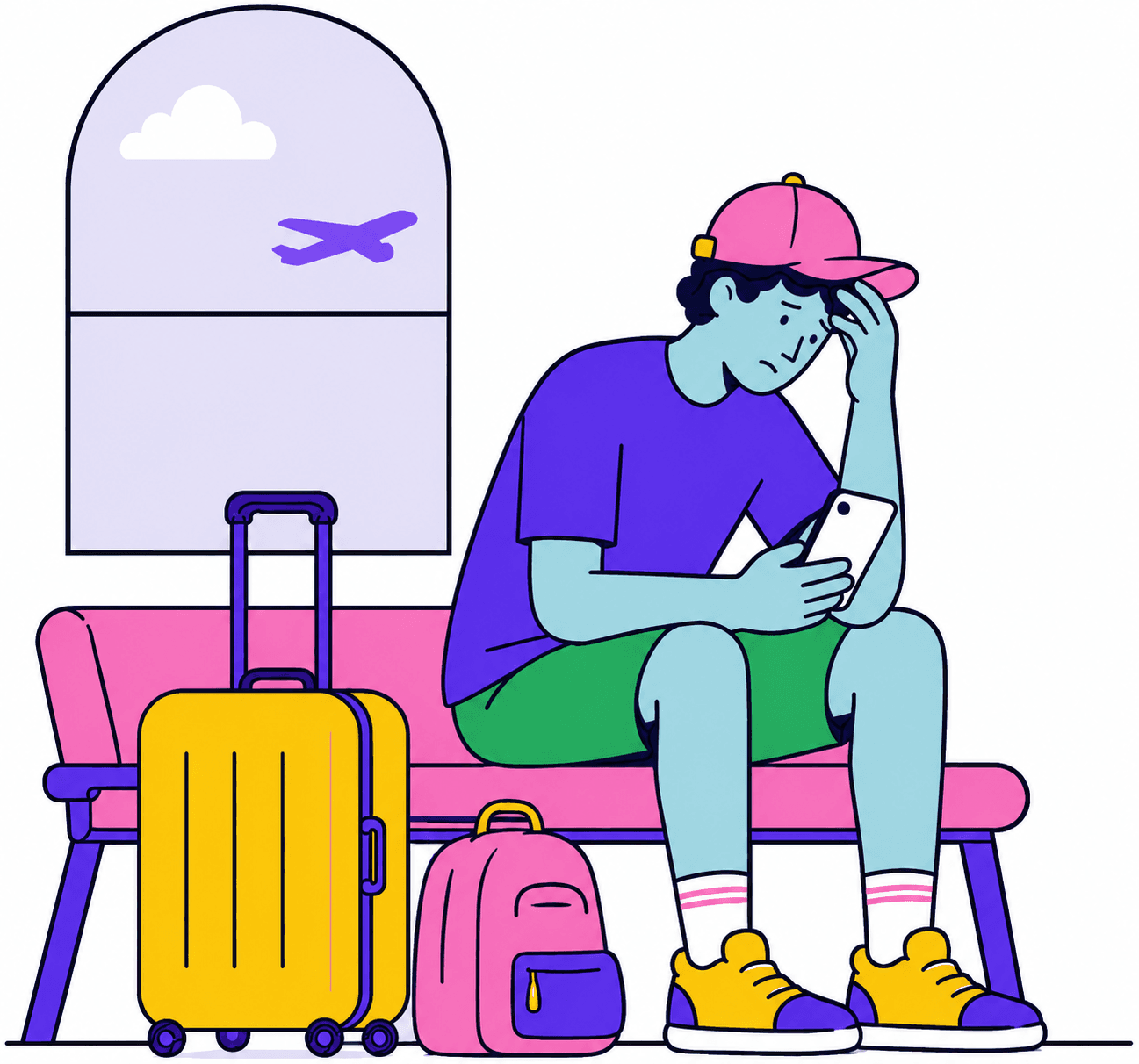
English-speaking doctors, licensed to treat you where you are.
A Migraine in a Hotel Room, Without Your Usual Medication
NHS describes the main symptoms as a throbbing headache that can be severe, is often on one side of the head and can be worse when you move around; feeling or being sick; and being very sensitive to light and sounds. Some people get warning signs called aura — problems with sight such as zigzag lines or flashing lights, numbness or a tingling that feels like pins and needles, feeling dizzy, or difficulty speaking.
On a trip two things change. The first is supply: the medication that usually works is often at home, and the pharmacy in front of you is unfamiliar, in another language, and stocking brands you do not recognise. The second is doubt. A bad headache in a strange place, in heat, after a flight, invites the question of whether this is really the usual thing — and that question is worth answering properly rather than lying in the dark hoping.
- Consult securely by video
- Avoid unnecessary travel and waiting rooms
- Get clear guidance about your symptoms and treatment
- Talk it through in English, wherever you are staying
What Video Can Settle, and What It Cannot
Much of assessing a migraine is the history — how an attack starts, what it does, how long it lasts and how it compares with your usual ones — which makes it well suited to a conversation.
Where a video consultation genuinely helps
- talking through what this attack is doing and how it compares with your usual ones
- whether the pattern sounds like migraine or like something that needs looking at properly
- which triggers this trip has supplied, and which of them you can still do something about
- what is reasonable to take, and what to ask for at a pharmacy that does not stock what you know
- how to manage the rest of the trip, including the flight home, around attacks
- what to do if attacks have become more frequent or more severe than they used to be
Almost all of this is history: how it starts, where the pain sits, how long it lasts, what comes with it, whether there is aura, what you normally take and whether it is working. A doctor asks those questions the same way over video as across a desk.
What needs urgent in-person care instead
- a sudden, severe headache unlike anything you have had before
- weakness or paralysis in an arm, a leg or one side of the face
- slurred or garbled speech, or sudden confusion
- a headache with a high temperature, a stiff neck or a rash
- a headache after a blow to the head
- seizures, double vision, or a headache that is clearly getting worse hour by hour
Pomodoc connects you with an English-speaking doctor by video for €40 per consultation. Fixed price, no surprises, and no subscription.
If what you are describing does not sound like your usual migraine, a doctor will say so and tell you where to go. That is the answer this page exists to make easy to get.
Your consultation runs on Air Doctor's ISO‑certified platform (ISO/IEC 27001 & ISO 27799 for health data). See our security & certifications.
How It Works
Medical advice by video in three simple steps
Start online
Tell us which country you are in and what your headache is doing. It is a short form, not an appointment request.
Join by video
See your English-speaking doctor using your phone, tablet or computer.
Get clear guidance
Discuss your symptoms and receive advice about your next steps.
Why Use Pomodoc?
From a dark room
You do not have to be upright, presentable or in a taxi. A consultation you can take lying down with the curtains shut is the right shape for this particular illness.
Explain it in English
Describe the aura, what the pain is doing and what you normally take, in English, rather than trying to mime it at a pharmacy counter in another language.
Straight about the limits
We will tell you plainly when what you are describing needs urgent in-person care rather than a conversation. On a headache, that judgement is the most valuable thing on offer.
One fixed price
€40 per consultation, whichever country you are in, with no insurance and no local registration needed.
Travellers who needed a doctor abroad
I was very happy to find this service
I was very happy to find this service! I was able to get a video visit with a physician promptly and get care.
Easy, competent, nice
Doctor was very nice and adequately thorough, explained everything very well. The whole process was far easier than expected.
Reliable and efficient
Reliable and efficient, able to provide medical support while you're away from home.
Reviews of Air Doctor, our medical partner, published on Trustpilot.
More About Migraine While Travelling
Migraine or an ordinary headache
NHS describes migraine as a throbbing headache that can be severe and is often on one side of the head, with feeling or being sick and being very sensitive to light and sounds. An ordinary tension headache is more often a dull, pressing pain on both sides that does not stop you functioning and does not bring the sickness and the light sensitivity with it.
The practical difference for a traveller is what it costs you. A tension headache is something you get through the afternoon with. A migraine is often an afternoon you have to give up, and planning the rest of the day around that honestly tends to work better than trying to push through a sightseeing schedule.
Aura, and why it can be alarming the first time
Some people get warning signs before a migraine attack, called aura. NHS lists problems with your sight, such as seeing zigzag lines or flashing lights; numbness or a tingling that feels like pins and needles; feeling dizzy; and difficulty speaking. It says aura symptoms should not last for longer than 1 hour.
Read as a list, those are also the symptoms of a stroke, and that is not a coincidence of wording — it is why anybody having them for the first time should be assessed rather than reassured by a website. NHS says aura lasting longer than 1 hour at a time needs urgent advice, and it puts problems speaking, losing your vision, and weakness on one side of the body or face on its emergency list. If symptoms like these come on suddenly, or do not go away, treat that as an emergency and not as a migraine.
What a trip adds to the trigger list
NHS says some people find certain triggers can cause migraine attacks, including having your period, anxiety and depression, stress and tiredness, skipping meals or not eating regularly, too much caffeine, and not getting enough regular exercise. Its self-care advice adds staying well hydrated, limiting caffeine and alcohol, eating at regular times and getting plenty of sleep. A trip is unusually good at working against several of those at once: a 5am airport start, a day without a proper meal, more coffee and more alcohol than usual, not enough water, and a room that is too warm to sleep well in.
That is worth more than it sounds, because unlike most trigger lists this one is partly actionable on the day. Water, food, a dark cool room and an earlier night are not a treatment for migraine, but they remove several of the things stacking against you — and for a lot of people they are the difference between one bad afternoon and three.
Flying, altitude and the day after a long journey
An attack in the day or two after a long flight is a common experience, and the honest explanation is the ordinary one rather than anything exotic: tiredness from the short night and the jet lag, skipped or disrupted meals and too much caffeine are on the NHS trigger list, NHS also advises staying well hydrated, and a long-haul trip works against all of that at once.
We are not going to give you a rule about whether to fly during an attack, because that depends on your symptoms, your history and your flight, and it is a good question for a doctor rather than a line on a landing page. If a flight consistently brings on symptoms that are new or different from your usual pattern, that is worth raising with your own doctor when you get home.
Medication left at home, and pharmacies abroad
This is the most common practical problem this page meets, and it deserves an honest answer rather than a sales one. A pharmacy abroad may stock something equivalent to what you take, may stock it under a name you do not recognise, and may or may not be able to sell it without a local prescription. Rules differ by country and we cannot promise any of it from here.
What a consultation can do is help you work out what you are actually looking for, what is reasonable to take alongside it, and what to ask for at the counter. A doctor may issue a prescription where it is clinically appropriate and local rules permit. It is not guaranteed, some medicines cannot be prescribed remotely at all, and medication you buy at a pharmacy is not included in the €40.
Good things to know.
What are the symptoms of a migraine?
NHS describes a throbbing headache that can be severe and is often on one side of the head, feeling or being sick, and being very sensitive to light and sounds. Some people also get warning signs beforehand, called aura: zigzag lines or flashing lights, numbness or a tingling like pins and needles, feeling dizzy, or difficulty speaking.
How is a migraine different from an ordinary headache?
A tension headache is typically a dull, pressing pain on both sides that you can carry on through. A migraine is usually one-sided and throbbing, is moderate to severe, and brings company — nausea, sometimes vomiting, and a strong dislike of light and noise. The sickness and the light sensitivity are the most useful distinguishing features in practice.
Why do I get migraines when I travel?
Probably because a trip supplies several known triggers at once. NHS lists stress and tiredness, skipping meals or not eating regularly, and too much caffeine among them, and an early flight, a skipped lunch, extra coffee and a late night deliver most of that in twenty-four hours. Triggers are individual, so the useful exercise is working out which ones are reliably yours.
When should I see a doctor about a migraine?
It is worth speaking to a doctor if attacks are frequent or severe, if they have changed in pattern, if what usually works has stopped working, or if this is the first attack of this kind you have had. Separately, and urgently: a sudden severe headache unlike any before, weakness or slurred speech, or a headache with a high temperature, stiff neck or rash needs emergency care rather than a consultation.
Can a doctor help with a migraine over video?
Yes, within limits worth naming. Much of assessing a migraine is the history, so the conversation covers a lot of it: what the pain does, what comes with it, whether there is aura, what you normally take and whether it is still working. What a video consultation cannot do is examine you when the concern is that this might not be a migraine — and in that situation a doctor will tell you to be seen in person.
Can I get my usual migraine medication while I am abroad?
We cannot promise that. A doctor may issue a prescription where it is clinically appropriate and local rules permit, but it is not guaranteed, some medicines cannot be prescribed remotely at all, and what a pharmacy can dispense varies by country. What a consultation can reliably do is help you work out what to look for and what to ask for. Medication you buy at a pharmacy is not included in the €40.
What helps during an attack when I am away from home?
The measures that help at home still help: a dark, quiet, cool room, fluids, and rest, alongside whatever painkiller you normally use and can safely take. It is not a cure, and if you are vomiting and cannot keep anything down, or an attack is lasting much longer than your usual ones, that is a reasonable point to speak to a doctor rather than to keep waiting it out. NHS says an attack lasting longer than 72 hours, aura lasting longer than 1 hour, or a migraine while pregnant or just after having a baby needs urgent advice.
Sources
- MigraineNHSChecked against the page as last reviewed 10 March 2026: the main symptoms of a throbbing headache that can be severe, often on one side of the head and worse when moving, feeling or being sick, and being very sensitive to light and sounds; the aura warning signs of problems with sight such as zigzag lines or flashing lights, numbness or tingling like pins and needles, feeling dizzy and difficulty speaking, and that aura symptoms should not last longer than 1 hour; the triggers of having your period, anxiety and depression, stress and tiredness, skipping meals or not eating regularly, too much caffeine and not getting enough regular exercise; the self-care advice of sleeping or lying down in a darkened room, staying well hydrated, limiting caffeine and alcohol, eating meals at regular times and getting plenty of sleep; the urgent-advice criteria of an attack lasting longer than 72 hours, aura lasting longer than 1 hour at a time, and being pregnant or having just had a baby; and the 999 signs of a headache that came on suddenly and is extremely painful, problems speaking or remembering things, losing vision or blurred or double vision, feeling drowsy or confused, a seizure, a very high temperature with symptoms of meningitis, being unable to move or having weakness in the arms or legs on one side of the body or one side of the face, and a recent head injury.
- HeadachesNHSThe description of a tension headache as the common kind, felt as a dull, constant pressing pain on both sides of the head that is not usually severe enough to stop you doing everyday activities — the comparison this page draws between an ordinary headache and a migraine — and the common causes including dehydration, missed meals, lack of sleep and stress.
Sources last checked: . General information, not a diagnosis.

Not Sure Whether This Is Your Usual Migraine?
Speak to an English-speaking doctor by video and get guidance from wherever you are staying.
- €40, fixed price
- English-speaking doctors
- No subscription
- Prescriptions where available
Video consultations are for suitable non-emergency medical concerns. A sudden severe headache unlike any before, weakness or slurred speech, or a headache with a high temperature, stiff neck or rash needs emergency care: call your local emergency number or go to the nearest emergency department. This page is general information, not medical advice about your own situation.