
Online doctor, Thailand
See an Online Doctor in Thailand By video, wherever you are staying.
Unwell in Thailand? Pomodoc connects you by video with an English-speaking doctor licensed to treat you in Thailand, for a fixed €40, from your hotel, your guesthouse or an island with a decent signal. You describe what is happening, a doctor assesses it, and you finish with a plan: rest and fluids, a pharmacy, or in-person care today — without first working out an unfamiliar healthcare system while you feel awful. In an emergency call 191 and ask for an ambulance, or call 1669.
Thailand has excellent care and two very different systems to reach it through. The useful first question for a minor illness is not which one — it is whether you need either.
- €40
- per consultation
- No insurance
- or hospital account needed
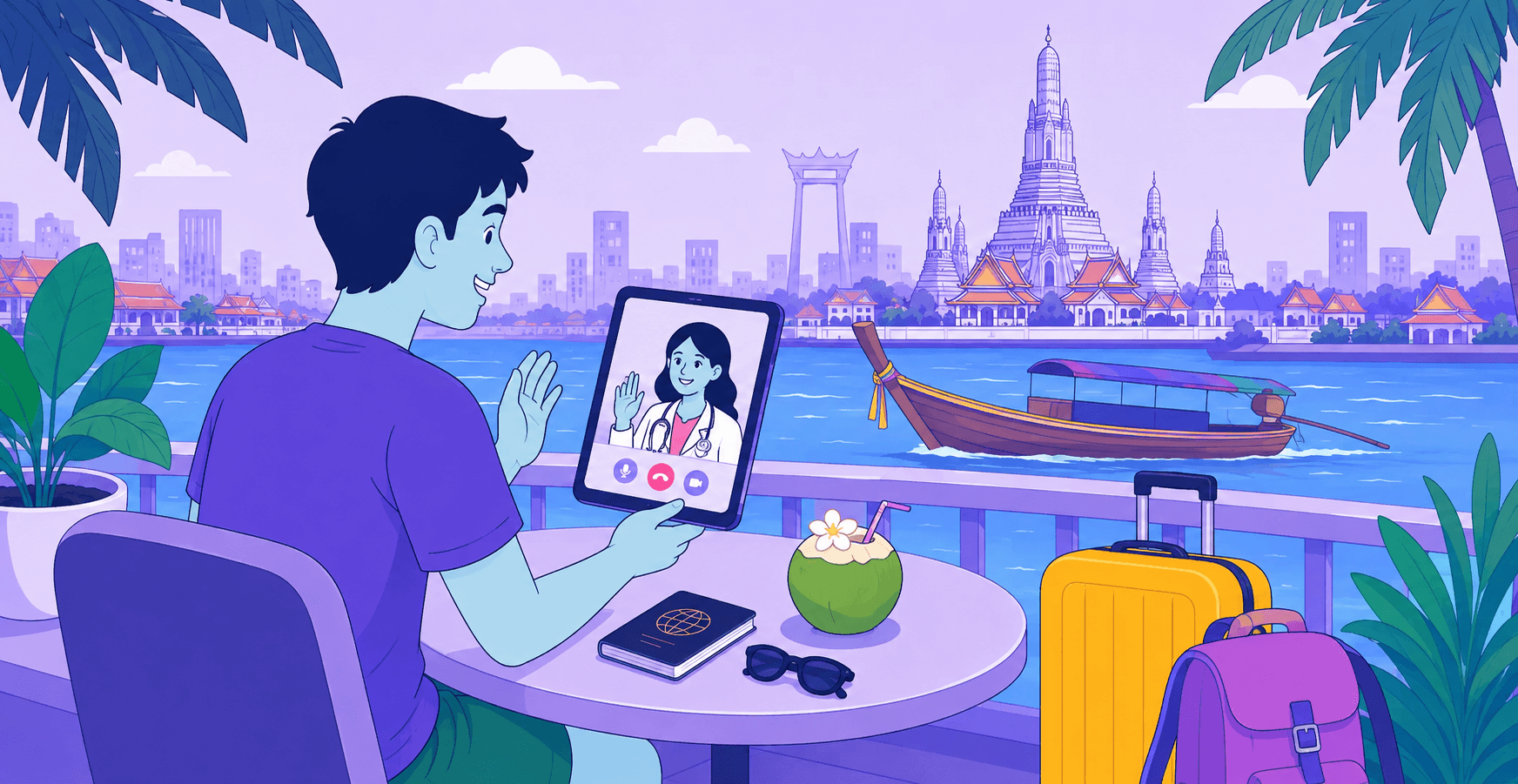
Video consultations with doctors licensed to treat you in Thailand.
Online Medical Advice, Anywhere in Thailand
Thailand has genuinely good medicine. What it does not have is an obvious front door for a minor illness: the choice is a public hospital or a private international one, and working out which of them a stomach upset or an angry insect bite belongs in is a decision most travellers are making for the first time, in an unfamiliar system, on the day they feel worst.
With Pomodoc you can speak directly with an English-speaking doctor wherever you are in Thailand — a Bangkok hotel, a guesthouse in Chiang Mai, a villa in Krabi, an island with a steady connection. Describe your symptoms, ask your questions, and finish knowing whether this needs rest and fluids, a pharmacy, or in-person care today.
That last answer is worth as much as the other two, because it comes with a reason you can take with you.
- Consult securely by video
- Avoid unnecessary travel and waiting rooms
- Get clear guidance about your symptoms and treatment
- Access care while travelling or living in Thailand
Private Hospital, Public Hospital, or Video?
Thailand gives you two obvious options when you fall ill, and for a minor problem neither is quite the right size. Here is what each route is actually for.
What is available around you
- private international hospitals, which FCDO describes as of a high standard but which can be expensive
- public hospitals, which FCDO says do not always meet UK standards, particularly outside Bangkok
- pharmacies, which FCDO says usually accept UK prescriptions, as Thai hospitals do
- 191 for an ambulance, the number FCDO gives, or 1669, the local ambulance number
Both hospital routes are real care and the private one is often excellent — the question a minor illness asks is which of them, if either, it needs. One practical FCDO note worth having before you set off rather than at the desk: all hospitals in Thailand require a guarantee of payment before treating patients, which is also why FCDO tells travellers to check their insurance covers local treatment.
What a video consultation adds
- someone to describe it to first, who can tell you which route you actually need
- a doctor who speaks English without depending on which hospital you reached
- guidance you can act on, rather than a decision you have to make alone
- somewhere to ask from, when the nearest clinic is a boat ride away
Pomodoc connects you with an English-speaking doctor by video, licensed to treat you in Thailand, for €40 per consultation. Fixed price, no surprises.
If you need to be seen in person, you will be told to go, and told why. Being sent somewhere with a reason is a good outcome of a consultation, not a failure of one.
Your consultation runs on Air Doctor's ISO‑certified platform (ISO/IEC 27001 & ISO 27799 for health data). See our security & certifications.
How It Works
An online consultation by video, in three simple steps
Start online
Tell us where you are in Thailand and what is going on. It is a short form, not an appointment request.
Join by video
See your English-speaking doctor using your phone, tablet or computer.
Get clear guidance
Discuss your symptoms and receive advice about your next steps.
Why Use a Video Doctor?
Someone to ask, before you decide anything
A doctor who can hear what is actually happening and tell you whether this needs a hospital, a pharmacy, or a day of rest. That is the question a minor illness abroad really asks.
Get help without leaving your accommodation
Attend your appointment from your hotel, guesthouse, villa or apartment.
It reaches the islands
Koh Samui, Koh Lanta, Koh Tao, Koh Phi Phi. What a video consultation needs is a connection steady enough to hold a call, not a clinic within reach.
Explain it in English
Describe your symptoms and ask questions in English, instead of hoping the clinic you reached has someone who speaks it.
Travellers who needed a doctor abroad
I was very happy to find this service
I was very happy to find this service! I was able to get a video visit with a physician promptly and get care.
Excellent doctor
Excellent doctor, very professional and friendly and speaks excellent english
Reliable and efficient
Reliable and efficient, able to provide medical support while you're away from home.
Reviews of Air Doctor, our medical partner, published on Trustpilot.
More About Seeing a Doctor in Thailand
Two tiers, and how to tell which one you need
FCDO describes private hospitals in Thailand as of a high standard but says they can be expensive, and says public hospitals do not always meet UK standards, particularly outside Bangkok. Both halves matter, and neither is a warning: the private route is genuinely good care and the public route is genuinely care. What is hard is not the quality, it is knowing which size of response your problem needs.
Two practical things belong beside that. FCDO says all hospitals in Thailand require a guarantee of payment before treating patients, so it is worth knowing your insurance position before you set off rather than at the desk — FCDO tells travellers to check their policy covers local treatment and medical evacuation. And for a serious problem, your insurer's assistance line is a route into a hospital they have vetted and may settle with directly.
Pharmacies, prescriptions and what not to buy
FCDO says Thai pharmacies and hospitals usually accept UK prescriptions, which is unusually helpful and worth knowing if you take something regularly. It adds that brand-name medication can often be more expensive than locally produced medication, so it is reasonable to ask what the local equivalent is.
It also says not to buy medication on the street, because it may not be genuine or may have been stolen. A pharmacy is a fair first stop for something minor; a street stall is not a pharmacy.
Mosquitoes are the risk that changes what a fever means
TravelHealthPro says there is a risk of dengue in Thailand and a risk of Zika virus, and that all travellers should avoid insect and tick bites day and night. Dengue is spread by mosquitoes that bite mainly in daylight, which is why bite avoidance here is not just an evening job.
It matters for what you do about a fever. Dengue is confirmed on a blood test rather than by eye, so a fever that arrives without an obvious cause in Thailand is a reason to be assessed rather than to wait it out — and a reason a consultation's most useful output may be being sent for a test.
Malaria: where there is a risk, and where there is not
TravelHealthPro says there is a low risk of malaria in the rural, forested borders of Thailand with Cambodia, Laos and Myanmar, and that there is no risk of malaria in the cities of Bangkok, Chiang Mai, Chiang Rai, Koh Phangan, Koh Samui and Pattaya.
That is a genuinely useful narrowing for most trips, and it is not a substitute for pre-travel advice: FCDO says to check the health information for your destination at least eight weeks before you travel, which is when antimalarials and vaccines are decided.
Animals, and the one thing that cannot wait
TravelHealthPro says rabies is considered a risk in Thailand and has been reported in domestic animals here, that most cases follow a bite or scratch from an infected dog, and that travellers should avoid contact with all animals. It also says that once rabies symptoms develop the condition is almost always fatal.
So a bite, a scratch or a lick to broken skin is not a wait-and-see. Wash it, and get medical care in person the same day, wherever you are. A video consultation is the wrong tool for it and this page will not pretend otherwise.
Stomach upsets are the common reason people look for a doctor
TravelHealthPro says all travellers to Thailand should take care with personal, food and water hygiene. Most of what sends a traveller here looking for a doctor is the result of not managing it — and most of it settles with rest, fluids and time.
It is also the kind of illness a video consultation suits, because the decision usually turns on hydration and warning signs rather than on an examination. Two guides below split it the way the question actually arrives: one for when you can name the meal, one for when you cannot.
Air quality in Bangkok and Chiang Mai
FCDO notes that high air pollution in Bangkok and Chiang Mai may worsen bronchial, sinus or asthma conditions. If you have any of those, that is worth planning for rather than discovering: carry your usual inhaler or treatment, and know what your own escalation looks like.
It is also a fair reason to use a consultation early rather than late. A chest that is tightening in bad air is a conversation a doctor can have with you before it becomes an emergency department.
Good things to know.
Can I see an online doctor in Thailand in English?
Yes. English is widely available in private international hospitals and in the main tourist areas, and FCDO publishes a list of medical facilities in Thailand where some staff will speak English. Who is available at the moment you need them, and what it will cost, are the harder questions. Pomodoc connects you with an English-speaking doctor by video, licensed to treat you in Thailand, for €40 per consultation.
Can I have an online consultation with a doctor in Thailand?
Yes. A Pomodoc online consultation is a video call, a form of telehealth: you speak with a doctor licensed to treat you in Thailand, in English, from your phone, tablet or computer, for a fixed €40. It suits non-emergency concerns where the decision rests on what you can describe and show on camera. If your symptoms need an examination, a swab or a test, the doctor will tell you so, and where to go.
What is the emergency number in Thailand?
FCDO says to dial 191 and ask for an ambulance; 1669 is the local ambulance number. 191 also reaches fire and police, and 199 is the fire service. FCDO also lists the Tourist Police on 1155 for tourist assistance. For chest pain, difficulty breathing, sudden weakness or confusion, heavy bleeding or someone who will not wake properly, call 191 or 1669 rather than booking anything.
Do Thai hospitals ask for payment before they treat you?
FCDO says all hospitals in Thailand require a guarantee of payment before treating patients. That is why it also advises checking that your travel insurance covers local treatment and medical evacuation before you travel. For a serious problem, your insurer's assistance line is a route into a hospital they have vetted and may settle with directly.
Does a video consultation work from the Thai islands?
It needs a connection steady enough to hold a video call, not a clinic within reach, so Koh Samui, Koh Lanta, Koh Tao and Koh Phi Phi are all workable. That is where the difference is largest: your in-person options on a small island may be one clinic with limited hours or a boat to somewhere bigger, and if you do need that boat it is better to start the journey knowing why.
I have a fever in Thailand. Could it be dengue?
It is a fair question to ask, and it is not one a screen can settle. TravelHealthPro says there is a risk of dengue in Thailand, and dengue is confirmed on a blood test rather than by eye. What a consultation can do is take a history, look at how you are doing, and tell you whether you should be tested in person and how urgently. Avoiding mosquito bites day and night is the advice TravelHealthPro gives everyone here.
An animal bit or scratched me in Thailand. Can a video doctor help?
No, and this is the one where the answer is a flat no. TravelHealthPro says rabies is a risk in Thailand and has been reported in domestic animals, that most cases follow a bite or scratch from an infected dog, and that the condition is almost always fatal once symptoms develop. Wash the wound and get medical care in person the same day, wherever you are.
Can a doctor prescribe for me in Thailand by video?
A doctor may issue a prescription when it is clinically appropriate and local rules permit. It is not guaranteed, and some medicines cannot be prescribed remotely at all. FCDO says Thai pharmacies and hospitals usually accept UK prescriptions, and that brand-name medication can often be more expensive than the locally produced equivalent. Medication you buy at a pharmacy is not included in the €40.
How much does a Pomodoc video consultation cost?
€40 is the fixed price of the video consultation with a doctor. It includes the consultation and, where clinically appropriate and local rules permit, a prescription. Medication you buy at a pharmacy, and any in-person care you go on to need, are separate. There is no subscription and no booking fee.
When is a video consultation not the right call?
Not when it is an emergency. Chest pain, difficulty breathing, sudden weakness or confusion, heavy bleeding, a bad injury or someone who will not wake properly are not video problems — in Thailand, call 191 and ask for an ambulance, or call 1669, first. Nor is an animal bite or scratch, which needs in-person care the same day. It is also not the right tool when a doctor needs to examine you, take a swab or run a blood test: if that is what your symptoms need, the useful outcome of the call is being told so early, and the guide above says which routes are better for that.
Sources
- Thailand travel advice: HealthForeign, Commonwealth and Development OfficeTo dial 191 and ask for an ambulance, with 1669 as the local number; that private hospitals are of a high standard but can be expensive; that public hospitals do not always meet UK standards, particularly outside Bangkok; that all hospitals require a guarantee of payment before treating patients; that FCDO publishes a list of medical facilities where some staff will speak English; that Thai pharmacies and hospitals usually accept UK prescriptions; that brand-name medication can often be more expensive than locally produced medication; the advice not to buy medication on the street because it may not be genuine or may have been stolen; the advice to check travel insurance covers local treatment and medical evacuation; the advice to check health information at least 8 weeks before travel; and that high air pollution in Bangkok and Chiang Mai may worsen bronchial, sinus or asthma conditions.
- Thailand travel advice: Getting helpForeign, Commonwealth and Development OfficeThe emergency numbers: 1669 for an ambulance, 191 for ambulance, fire and police, 199 for fire, and the Tourist Police on 1155 for tourist assistance.
- Thailand: country informationTravelHealthPro (NaTHNaC)That there is a risk of dengue and a risk of Zika virus in Thailand; that all travellers should avoid insect and tick bites day and night; that rabies is considered a risk and has been reported in domestic animals, that most cases follow a bite or scratch from an infected dog, and that the condition is almost always fatal once symptoms develop; that there is a low risk of malaria in the rural forested borders with Cambodia, Laos and Myanmar and no risk in Bangkok, Chiang Mai, Chiang Rai, Koh Phangan, Koh Samui and Pattaya; and that all travellers should take care with personal, food and water hygiene.
Sources last checked: . General information, not a diagnosis.
Need an Online Doctor in Thailand?
Speak to an English-speaking doctor by video and get a clear answer from wherever you are staying.
- €40, fixed price
- Licensed in Thailand
- English-speaking doctors
- Prescriptions where available
Video consultations are for suitable non-emergency medical concerns. In a life-threatening emergency in Thailand, call 191 and ask for an ambulance (the local ambulance number is 1669), or go to the nearest emergency department. This page is general information, not medical advice about your own situation.