
Online doctor, Thailand
Travellers' Diarrhoea in Thailand Bangkok belly, and what to do.
Diarrhoea a few days into Thailand, with no particular meal to blame? That is travellers' diarrhoea, and it is what all the local names describe. TravelHealthPro defines it as three or more unformed stools in 24 hours, says it usually settles in three to four days, and says rehydration is the main treatment. Pomodoc connects you by video with an English-speaking doctor licensed to treat you in Thailand, for a fixed €40, to judge how dehydrated you sound and whether this needs a hospital. TravelHealthPro says a fever of 38°C or more, blood or mucus in the stool, or severe abdominal pain mean seeking medical care immediately. In a medical emergency, call 1669 for an ambulance.
It is not the chilli. Travellers' diarrhoea is an infection picked up from food or water, which is why a spice-free week does not prevent it and why rehydration, not blandness, is the treatment.
- €40
- per consultation
- No insurance
- or hospital account needed
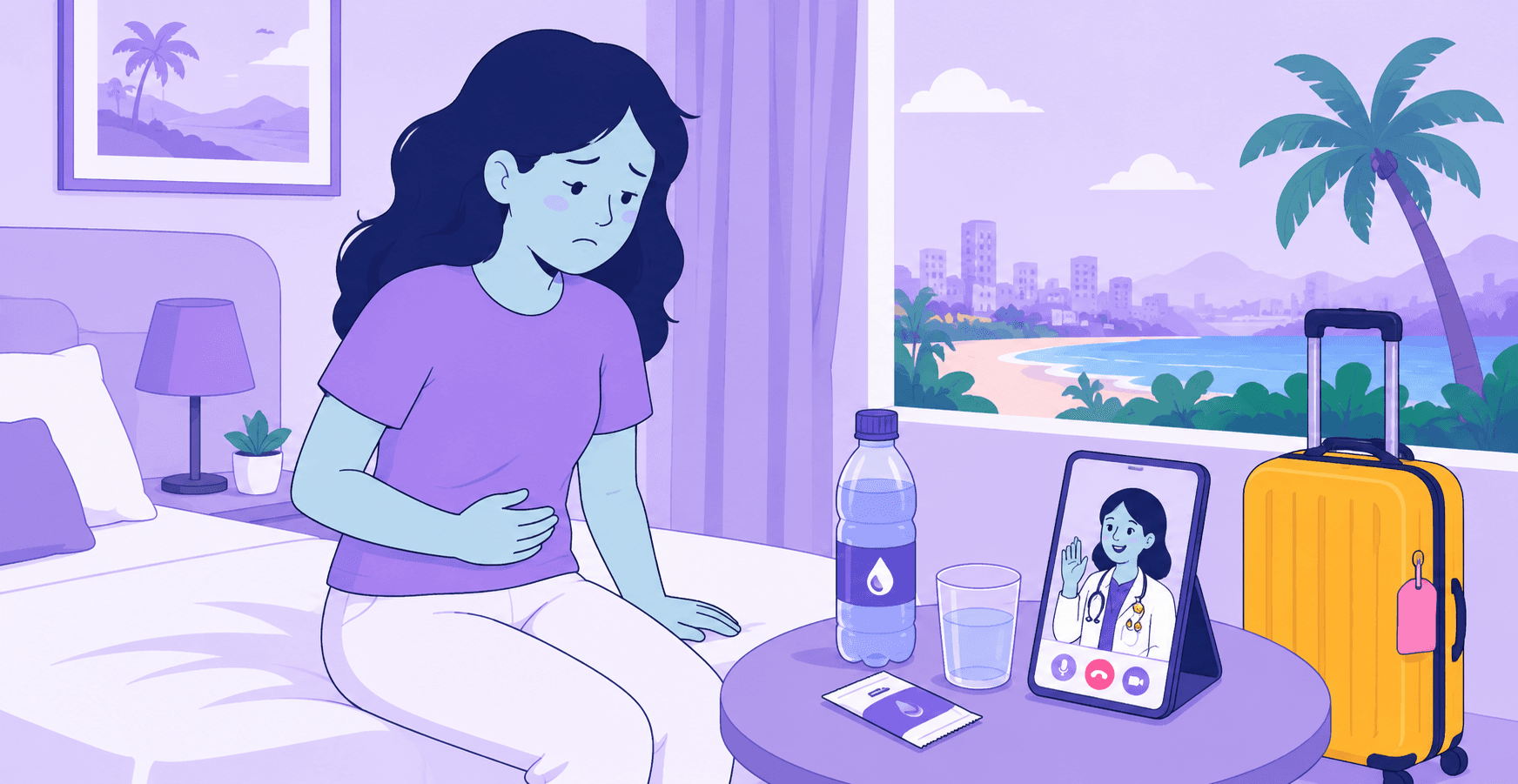
English-speaking doctors, licensed to treat you in Thailand.
Bangkok Belly, Thai Belly, Thai Tummy
They are all the same thing, and the medical name for it is travellers' diarrhoea. None of the nicknames is a separate illness, none of them is particular to Bangkok, and none of them means you have something unusual. They are what a very common holiday complaint gets called by the people who have had it.
TravelHealthPro defines travellers' diarrhoea as three or more unformed stools in a 24-hour period, often with at least one of fever, nausea, vomiting, cramps or bloody stools. It usually settles within three to four days, and it can start during the trip or within ten days of getting home. Rehydration is the main treatment; NHS guidance says diarrhoea and vomiting usually stop in a few days and can usually be treated at home.
With Pomodoc you can speak with an English-speaking doctor by video wherever you are in Thailand — a Bangkok hotel, a guesthouse, a boat, an island — describe what is happening and how much you are keeping down, and get a clear answer on whether this needs more than fluids and time.
- Consult securely by video
- Avoid unnecessary travel and waiting rooms
- Get clear guidance about your symptoms and treatment
- Access care while travelling or living in Thailand
Pharmacy, Hospital, or Video?
In Thailand the question is rarely whether care exists. It is which of the routes in front of you is right for a stomach upset, and in what order.
The pharmacy and the hospital
- a pharmacy, where you can ask about oral rehydration salts, which is the main thing this illness needs
- private international hospitals, which FCDO says are of a high standard but can be expensive
- public hospitals, which FCDO says do not always meet UK standards, particularly outside Bangkok
- FCDO's rule that applies to both: all hospitals require a guarantee of payment before treating patients
For an ordinary case, rehydration salts and a day of doing nothing may be the whole answer, and no route above is needed. What none of them gives you is a clinician's judgement on whether yours is ordinary — and in a country where every hospital asks for a payment guarantee at the door, that judgement is worth having before you go and not after.
A video consultation instead gives you
- a doctor who takes a history and judges how dehydrated you sound
- an answer on whether this needs a hospital at all, before you commit to one
- thresholds for overnight, so you know when to stop waiting
- a view on whether you are fit for tomorrow's boat, bus or flight
Pomodoc connects you with an English-speaking doctor by video, licensed to treat you in Thailand, for €40 per consultation. Fixed price, no surprises.
If the answer is rehydration salts and rest, you will be told that, and it did not cost you a hospital trip to find out.
Your consultation runs on Air Doctor's ISO‑certified platform (ISO/IEC 27001 & ISO 27799 for health data). See our security & certifications.
How It Works
Medical advice by video in three simple steps
Start online
Tell us where you are in Thailand and what is going on. It is a short form, not an appointment request.
Join by video
See your English-speaking doctor using your phone, tablet or computer.
Get clear guidance
Discuss your symptoms and receive advice about your next steps.
Why Use Pomodoc?
You do not have to leave the room
This is the illness where getting anywhere is the hardest part. A consultation happens where you already are, including on an island where the alternative is a boat.
A clinician's view on antibiotics
Whatever a counter will sell you, rehydration is the main treatment and most cases do not need antibiotics. Whether yours does is a doctor's call, not a shelf's.
Know whether you are fit to travel tomorrow
A ferry, an overnight bus or an internal flight is a different decision when you cannot keep fluids down. It is a fair thing to ask a doctor.
Understand what to do next
A doctor can help you decide whether you need treatment, rehydration support or an in-person appointment.
Travellers who needed a doctor abroad
I was very happy to find this service
I was very happy to find this service! I was able to get a video visit with a physician promptly and get care.
Easy, competent, nice
Doctor was very nice and adequately thorough, explained everything very well. The whole process was far easier than expected.
Reliable and efficient
Reliable and efficient, able to provide medical support while you're away from home.
Reviews of Air Doctor, our medical partner, published on Trustpilot.
More About Stomach Upsets in Thailand
It is not the spice, and that matters practically
Travellers' diarrhoea is an infection, picked up from food or water rather than from heat on the tongue. That is why a week of ordering everything mild does not prevent it, and why the treatment is fluids rather than blandness.
It also explains why it so often arrives with no meal you can blame. TravelHealthPro says all travellers in Thailand should take care with personal, food and water hygiene — hands and water and ice, not just the plate — and a low-dose exposure from any of those is rarely something you would remember. If you CAN name a meal, especially one that made someone else ill, the food poisoning guide is the better page for you.
Rehydration, and the signs to watch
NHS guidance is lots of fluids, in small sips if you feel sick, and no fruit juice or fizzy drinks because they can make diarrhoea worse. Oral rehydration salts replace the salts and water a heavy episode takes out of you. Mix them with water you would otherwise be happy to drink.
Keep an eye on the dehydration signs: great thirst, dark urine, passing very little and dizziness on standing are worth acting on rather than sitting out.
How long it should last, and what the clock is for
TravelHealthPro says travellers' diarrhoea usually resolves within three to four days, and that it can begin during the trip or within ten days of returning home. NHS puts its outer limits at more than seven days of diarrhoea or more than two days of vomiting.
Those numbers are not a sentence to serve. They are the line that stops a traveller talking herself into a fifth day when something else is going on — and the decision at that line usually turns on hydration and warning signs rather than on an examination, which is exactly the decision a video consultation is good at.
Antibiotics are a doctor's call, not a counter's
TravelHealthPro says rehydration is the mainstay of management and that antibiotic treatment is generally reserved for higher-risk cases rather than used routinely. It also records that the antibiotics once used as first-line for travellers' diarrhoea are no longer recommended, because of increasing resistance and safety concerns about potentially disabling side effects.
No drug is named on this page for that reason. Whether treatment is appropriate at all depends on your symptoms, your history and how you are doing, and a short conversation is a cheap way to get that judgement before you buy something you may not need.
Boats, buses and flights while you are ill
This is the Thailand-specific complication and it is a logistics problem before it is a medical one. A ferry between islands, an overnight bus, a sleeper train or an internal flight are all several hours without a reliable bathroom and without fluids you control.
The useful question is not whether you feel up to it but whether you are keeping fluids down, and it is a reasonable thing to put to a doctor. Distance is also a reason to act earlier on the warning signs, not later: on a small island or mid-journey, the gap between deciding you need a hospital and reaching one is measured in boats.
When it is not just a stomach upset
TravelHealthPro's immediate-care signs — a fever of 38°C or more, blood or mucus in the stool, severe abdominal pain, jaundice, rash or altered mental status — are the line between rehydrating and being seen now. In Thailand that means a hospital, and 1669 for an ambulance in an emergency.
One Thai particular is worth holding alongside them: TravelHealthPro says there is a risk of dengue here, and dengue is confirmed on a blood test rather than by eye. A high fever with headache and aching, rather than the cramps-and-fluids pattern above, is a reason to be assessed rather than to keep waiting. TravelHealthPro also gives a low risk of malaria in the rural, forested borders with Cambodia, Laos and Myanmar, a very low risk in the rest of the country, and no risk in Bangkok, Chiang Mai, Chiang Rai, Koh Phangan, Koh Samui and Pattaya; it says a fever of 38°C or more starting more than a week after being in a malaria risk area needs immediate medical care.
Good things to know.
What is Bangkok belly?
It is travellers' diarrhoea in Thailand. Bangkok belly, Thai belly, Thailand belly, Phuket belly and Thai tummy all name the same illness, and none of them is particular to the city or island in the name. TravelHealthPro defines it as three or more unformed stools in a 24-hour period, often with fever, nausea, vomiting, cramps or bloody stools, and says it usually settles within three to four days with rehydration as the main treatment.
Is Bangkok belly caused by spicy Thai food?
No. Travellers' diarrhoea is an infection picked up from contaminated food or water, not a reaction to chilli, which is why ordering everything mild does not prevent it. It is also why the treatment is rehydration rather than a bland diet, although eating gently while you recover is reasonable if that is what you can manage.
How long does Bangkok belly last?
TravelHealthPro says travellers' diarrhoea usually resolves within three to four days, and that it can start during the trip or within ten days of getting home. NHS says to get advice if diarrhoea lasts more than seven days or vomiting more than two. Beyond those lines, or at any point with a fever of 38°C or more, blood or mucus in the stool or severe abdominal pain, seek medical care rather than waiting it out.
Should I take antibiotics for diarrhoea in Thailand?
Not as a first step, and not on the strength of what a counter will sell you. TravelHealthPro says rehydration is the mainstay and that antibiotics are generally reserved for higher-risk cases, and it records that the drugs once used first-line for this are no longer recommended because of increasing resistance and safety concerns. Whether treatment is appropriate for you is a clinical judgement — ask a doctor before you buy.
What should I ask a Thai pharmacy for?
Oral rehydration salts, mixed with water you would otherwise be happy to drink. They replace the salts and fluid a heavy episode takes out of you, which is the treatment TravelHealthPro puts first. FCDO says Thai pharmacies usually accept UK prescriptions, and warns against buying medication on the street because it may not be genuine or may have been stolen.
Can I take a ferry or a flight with travellers' diarrhoea?
It depends less on how you feel than on whether you are keeping fluids down, and it is a fair question to put to a doctor before you commit to several hours without a reliable bathroom. If you are dehydrated, or you have any of the immediate-care signs, the journey is the wrong problem to be solving. Distance is also a reason to act earlier on those signs on an island than you would in a city.
How much does a Pomodoc video consultation cost?
€40 is the fixed price of the video consultation with a doctor. It includes the consultation and, where clinically appropriate and local rules permit, a prescription. Medication you buy at a pharmacy, and any in-person care you go on to need, are separate. There is no subscription and no booking fee.
When is a video consultation not the right call?
Not when TravelHealthPro's immediate-care signs are present — a fever of 38°C or more, blood or mucus in the stool, severe abdominal pain, jaundice, rash or altered mental status — and not when you cannot keep fluids down or show signs of dehydration. In Thailand, call 1669 for an ambulance in a medical emergency. It is also not the right tool when a doctor needs to examine you or run a blood test; if that is what your symptoms need, the useful outcome of the call is being told so early.
Sources
- Travellers' diarrhoeaTravelHealthPro (NaTHNaC)The definition — three or more unformed stools in a 24-hour period, often with fever, nausea, vomiting, cramps or bloody stools; that it usually resolves within three to four days and may occur during travel or within ten days of returning home; that rehydration is the mainstay of management; the immediate-care thresholds of a fever of 38°C or more, blood or mucus in the stool, severe abdominal pain, jaundice or altered mental status; that infants, young children, older travellers and pregnant women should seek early advice if not tolerating fluids or showing dehydration signs such as great thirst, sunken eyes or reduced skin elasticity; and that the antibiotics formerly used first-line are no longer recommended because of increasing resistance and safety concerns, with antibiotic treatment generally reserved for higher-risk cases.
- Diarrhoea and vomitingNHSThat diarrhoea and vomiting should stop in a few days and can usually be treated at home; that the most important thing is lots of fluids to avoid dehydration, taken in small sips; avoiding fruit juice and fizzy drinks; the dehydration signs; and the reasons to get advice including being unable to keep fluids down, bloody diarrhoea, diarrhoea for more than seven days or vomiting for more than two days.
- Thailand: country informationTravelHealthPro (NaTHNaC)That all travellers to Thailand should take care with personal, food and water hygiene; that there is a risk of dengue in Thailand; that there is a low risk of malaria in the rural, forested borders with Cambodia, Laos and Myanmar, a very low risk in the remaining areas, and no risk in the cities of Bangkok, Chiang Mai, Chiang Rai, Koh Phangan, Koh Samui and Pattaya; and that travellers who develop a fever of 38°C or more more than one week after being in a malaria risk area should seek immediate medical care (re-checked 2026-10-01).
- Thailand travel advice: HealthForeign, Commonwealth and Development OfficeThat private hospitals are of a high standard but can be expensive; that public hospitals do not always meet UK standards, particularly outside Bangkok; that all hospitals require a guarantee of payment before treating patients; that Thai pharmacies and hospitals usually accept UK prescriptions; the advice not to buy medication on the street because it may not be genuine or may have been stolen; and FCDO's emergency medical advice to dial 191 and ask for an ambulance, with 1669 as the local ambulance number (re-checked 2026-10-01).
Sources last checked: . General information, not a diagnosis.

Need Medical Advice in Thailand?
Speak to an English-speaking doctor by video and get guidance from wherever you are.
- €40, fixed price
- Licensed in Thailand
- English-speaking doctors
- Prescriptions where available
Video consultations are for suitable non-emergency medical concerns. In a life-threatening emergency in Thailand, call 1669 and ask for an ambulance. This page is general information, not medical advice about your own situation.