
Paying for it yourself
An Online Doctor Without Insurance €40, fixed, wherever you are.
You do not need insurance to speak to a doctor with Pomodoc. There is no policy number to find, no assistance line to call first, no pre-authorisation and no approved-clinic list to work through. You request a video consultation, you pay €40, and you talk to an English-speaking doctor licensed to treat you where you are. That is the whole arrangement, and the price is the same whether you are insured or not.
This is self-pay access to a doctor, not a substitute for travel insurance. FCDO's advice to hold cover stands, and the reasons for it are further down this page.
- €40
- per consultation
- No insurance
- or local registration needed
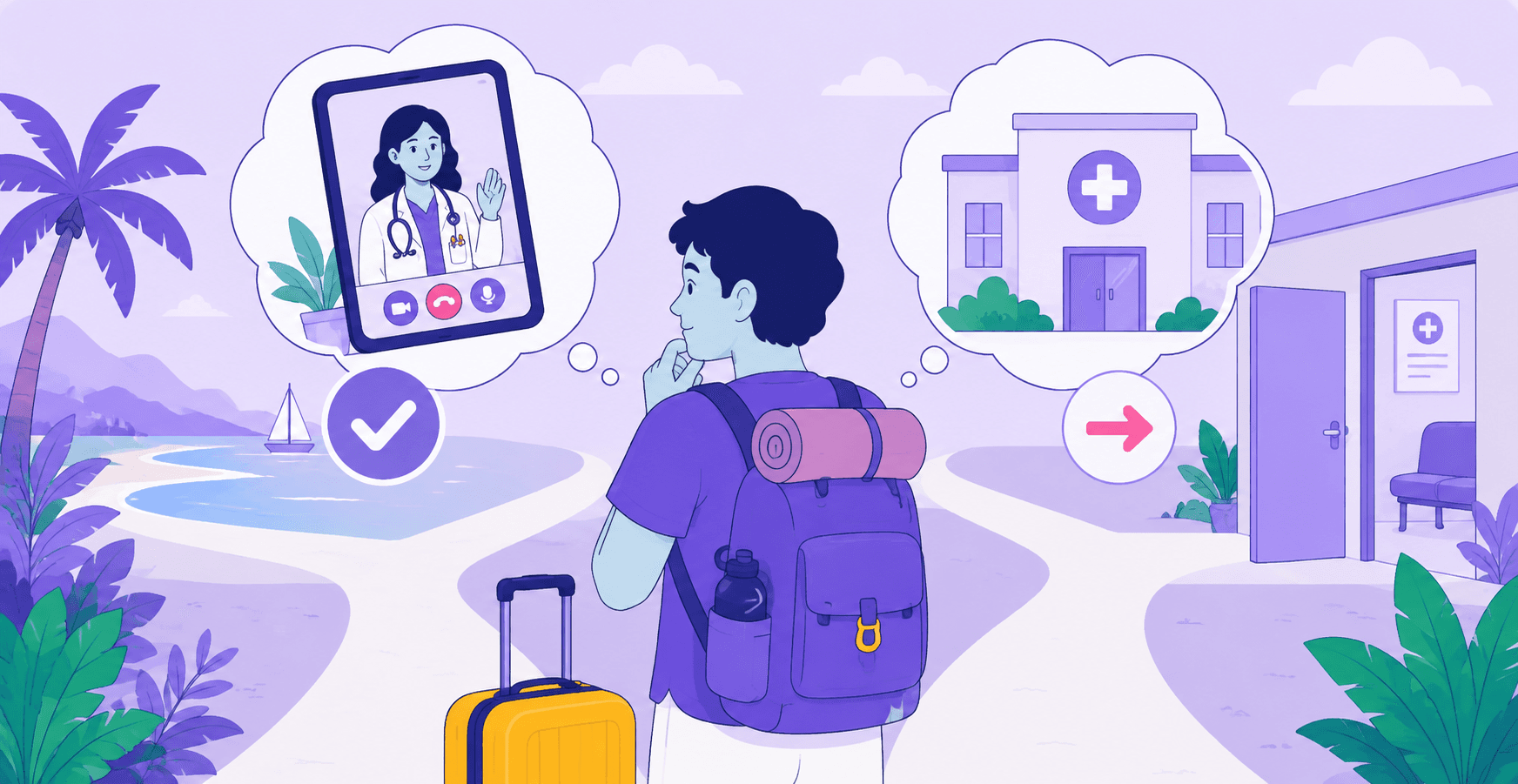
English-speaking doctors, licensed to treat you where you are.
Why Travellers Pay Directly
Two kinds of reader arrive here. One has no travel insurance, or has a policy that does not cover what has happened. The other has insurance and has looked at what using it involves — an assistance line, a wait for a callback, pre-authorisation, an approved clinic to find — and decided that for a sore throat on a Tuesday evening it is more process than the problem deserves.
Both of them want the same thing, which is to skip the administration and get a medical opinion. Paying directly does that: the fee is fixed and shown before you commit, so the anxiety about an unknown bill is answered before you start rather than at the till afterwards.
What it does not do is make insurance irrelevant, and this page is not going to pretend otherwise. A consultation is a conversation with a doctor. It is not cover for a hospital admission, an operation or a flight home, and those are the things insurance exists for.
- No insurance or local registration needed
- One fixed price, shown before you commit
- Consult securely by video, from where you are
- Find out whether in-person care may be needed
Claim Through Insurance, or Just Pay?
For a serious medical event, insurance is the route and it is not close. For a non-emergency question you want answered this evening, the arithmetic is different — and you are allowed to choose.
Going through insurance is the right route when
- you may need in-person treatment, a hospital, or an operation
- you may need to be brought home, which no consultation covers
- the costs could be large: FCDO puts a broken leg in Spain at over £25,000
- your policy requires you to call its assistance line before you get care
- you are eligible for state care under a GHIC or EHIC and the local system is where you belong
None of that is an argument against having a conversation with a doctor first. Often the useful outcome of a consultation is being told that this is exactly the situation your policy is for, and being told early.
Paying €40 directly makes sense when
- you have no insurance, or your policy does not cover the situation
- the problem is a non-emergency question rather than an event
- you want to know tonight whether this needs a local clinic at all
- the process of claiming would take longer than the illness
- you want the cost fixed and visible before you commit to anything
Pomodoc connects you with an English-speaking doctor by video, licensed to treat you where you are, for €40 per consultation. Fixed price, no surprises.
Nothing about paying directly closes the insurance door. Keep the receipt: many policies let you claim an out-of-pocket medical expense back afterwards, and whether yours does is a question for your policy rather than for us.
Your consultation runs on Air Doctor's ISO‑certified platform (ISO/IEC 27001 & ISO 27799 for health data). See our security & certifications.
How It Works
Medical advice by video in three simple steps
Start online
Tell us where you are and what is going on. No policy number, no insurer, no local registration. It is a short form, not an appointment request.
Join by video
See your English-speaking doctor using your phone, tablet or computer.
Get clear guidance
Discuss your symptoms and receive advice about your next steps.
Why Use Pomodoc?
You do not have to solve the system first
Working out how a foreign health service handles a visitor, and whether you count as one, is a project. A consultation is a starting point that does not require you to finish it.
One price, and you see it first
€40 for the consultation, fixed. No co-pay, no deductible, no out-of-network surprise, and no subscription to join before you can ask a question.
No policy number to find
No assistance line, no pre-authorisation, no approved-provider list. That matters most in the evening, which is when people actually feel unwell.
Explain it in English
Describe your symptoms and ask questions in English, rather than translating them first at a counter in a language you do not have.
Travellers who needed a doctor abroad
I was very happy to find this service
I was very happy to find this service! I was able to get a video visit with a physician promptly and get care.
Easy, competent, nice
Doctor was very nice and adequately thorough, explained everything very well. The whole process was far easier than expected.
Reliable and efficient
Reliable and efficient, able to provide medical support while you're away from home.
Reviews of Air Doctor, our medical partner, published on Trustpilot.
More About Paying for a Doctor Abroad
What self pay actually means here
It means the transaction is between you and the service, with no third party deciding first whether you are covered. You request a consultation, the price is shown, you pay by card. There is no claim form, no reference number and nobody to authorise it.
Two mechanics are worth knowing because they are in the Terms rather than in the marketing. A hold is placed on your card when the appointment is confirmed and the charge itself lands after the consultation. And if the doctor does not attend, the hold is released.
€40 is a fixed price, which is a statement about stability: the number does not move depending on what you turn out to have, how long the conversation takes, or what day it is. It is deliberately not a statement that €40 covers everything you might go on to need, which is the next section.
What the €40 covers, and what it does not
It covers the video consultation with a doctor, and — where it is clinically appropriate and local rules permit — a prescription. A prescription is not guaranteed for every consultation, and some medicines cannot be prescribed by video at all.
It does not cover medication. Anything you go on to buy at a pharmacy is a separate cost, paid to the pharmacy.
It does not cover in-person care of any kind: not a clinic appointment, not an examination, not a test, not a hospital admission, not an operation, and not a flight home. If the outcome of the consultation is that you need to be seen, being seen is separate and is paid for separately. That is precisely the territory travel insurance exists for, and it is why the next section is on this page rather than left out of it.
Insurance still matters, and here is the arithmetic
FCDO is direct about it: if you do not have appropriate insurance before you travel, you could be liable for emergency expenses, including medical treatment, which may cost thousands of pounds. It publishes worked examples — a broken leg in Spain needing hospital treatment at over £25,000, a quad bike accident in Greece needing surgery and evacuation at over £80,000, and a stomach bug requiring a hospital stay in the United States with possible evacuation at over £150,000.
A €40 consultation does not touch any of that and is not offered as though it does. What it can reasonably do is help you find out earlier whether you are heading towards that kind of situation, which is worth something on its own.
The honest position is the one FCDO takes: hold cover, and use it when it is the right tool. Paying €40 directly for a conversation with a doctor is a small, separate decision that does not replace it.
GHIC and EHIC are not insurance either
A UK Global Health Insurance Card or European Health Insurance Card gives access to necessary state healthcare in the European Economic Area and some other countries, on the same basis as a resident — which means on the same terms a local pays, not free.
FCDO states plainly that EHIC and GHIC are not alternatives to travel insurance, because they do not cover private medical healthcare costs, repatriation, or additional costs such as mountain rescue in ski resorts. The NHS's own page says the same: not medical repatriation, not treatment in a private medical facility, not ski or mountain rescue.
The European Commission's own guidance for travellers adds the practical caveat: health care systems vary from one EU country to another, in some countries you may have to pay the doctor or the hospital directly, and the card is only accepted by providers affiliated to the statutory system — private care is not covered by it, and where private care is used only a partial reimbursement may be claimable.
For a Pomodoc consultation none of this applies in either direction: you need no card, no registration and no eligibility check. Carry one anyway if you are eligible, for the situation nobody plans for.
Claiming it back afterwards
Paying directly and having insurance are not mutually exclusive, and choosing to pay for a small thing yourself does not affect a policy you hold for the big things.
Many travel policies allow an out-of-pocket medical expense to be claimed back after the trip. Whether yours does, at what threshold, and with what evidence, is a question for your policy documents and your insurer — we cannot promise a reimbursement on their behalf and this page does not.
What is worth doing either way is keeping the receipt, and noting the date and what the consultation was about. It costs nothing at the time and it is the thing people wish they had a month later.
Good things to know.
Can I see an online doctor without insurance?
Yes. Pomodoc needs no insurance, no policy number and no local registration. You request a video consultation, pay a fixed €40 by card, and speak with an English-speaking doctor licensed to treat you where you are. The price is the same whether you hold insurance or not.
Do I need travel insurance to request a consultation?
No. Nothing about the consultation depends on you having cover. Separately, FCDO advises travellers to hold appropriate insurance, and its reason is worth reading: without it you could be liable for emergency expenses that may cost thousands of pounds. Those are different questions, and the answer to the first one is still no.
What does the €40 include?
The video consultation with a doctor, and — where it is clinically appropriate and local rules permit — a prescription. It does not include medication you buy at a pharmacy, and it does not include any in-person care you go on to need: a clinic visit, an examination, a test, hospital treatment or a flight home are all separate. There is no subscription and no booking fee.
Is Pomodoc a replacement for travel insurance?
No, and it is not offered as one. A consultation is a conversation with a doctor. Insurance is what covers hospital treatment, surgery, evacuation and repatriation, and FCDO's own examples of what those cost run from £25,000 to £150,000. Hold cover, and treat a €40 consultation as a separate, much smaller decision.
Can I claim the €40 back from my insurer?
Many policies allow out-of-pocket medical expenses to be claimed back after a trip, and a consultation receipt is the kind of thing that is usually claimable. Whether yours qualifies, at what threshold and with what evidence is a matter for your policy and your insurer, and we cannot promise a reimbursement on their behalf. Keep the receipt, and note the date and what it was about.
What happens if I need in-person care afterwards?
Then the doctor will tell you so, and that is one of the more useful outcomes a consultation can have — knowing which kind of local service you need, and how urgently, before you spend a day finding out. In-person care is arranged and paid for separately, and it is where insurance or a GHIC becomes relevant. Our country guides set out what the local pathway looks like in the places we cover.
Do I need a GHIC or EHIC card?
Not for a video consultation, which needs no card and no eligibility check. Carry one anyway if you are eligible: it gives access to necessary state healthcare in the EEA and some other countries on the same basis as a resident. FCDO is clear that it is not an alternative to travel insurance, because it does not cover private healthcare costs, repatriation, or things like mountain rescue.
When is a video consultation not the right call?
Not for an emergency. Chest pain, severe difficulty breathing, signs of a stroke, a serious injury or someone who has passed out and is not responding normally all need the local emergency number — 112 across the EU, free from any phone. It is also not the right tool when a doctor needs to examine you, take a swab or run a test; if that is what your symptoms need, being told so early is the useful outcome of the call.
Sources
- Foreign travel insuranceGOV.UK (Foreign, Commonwealth and Development Office)That without appropriate insurance before travelling you could be liable for emergency expenses, including medical treatment, which may cost thousands of pounds; the worked examples of a broken leg in Spain needing hospital treatment at over £25,000, a quad bike accident in Greece needing surgery and evacuation at over £80,000, and a stomach bug requiring a hospital stay in the United States with possible evacuation at over £150,000; that a policy should be checked for cover of treatment in state or private hospitals, emergency transport such as an ambulance, emergency travel home on medical grounds and getting home after medical treatment; that a GHIC or EHIC allows access to state-provided medically necessary healthcare within the EU, Switzerland and some other countries; and that EHIC and GHIC are not alternatives to travel insurance because they do not cover private medical healthcare costs, repatriation or additional costs such as mountain rescue in ski resorts.
- Apply for a free UK Global Health Insurance Card (GHIC)NHSThat a GHIC gives access to necessary state healthcare in the European Economic Area and some other countries on the same basis as a resident; the countries covered; and that it does not cover being flown back to the UK, treatment in a private medical facility, or ski or mountain rescue, and is not a replacement for travel and medical insurance.
- 112, the European emergency numberEuropean CommissionThat 112 is free of charge, works from fixed and mobile phones everywhere in the EU, reaches an ambulance, the fire brigade or the police, and operates alongside national numbers.
- Going to a doctor or hospital abroadEuropean Commission (Your Europe)That health care systems vary from one EU country to another and that in some countries you might have to pay the doctor or the hospital directly; that a European Health Insurance Card makes administration and reimbursement for public health care easier but is only accepted by doctors or hospitals affiliated to the statutory health care system, with private health care not covered; and that where private care is used only a partial reimbursement may be claimable.
- When to call 999NHSThat 999 is for life-threatening emergencies such as serious road traffic accidents, strokes and heart attacks.
- Heart attackNHSThat chest pain that feels tight or like squeezing, or that spreads to the arms, neck or jaw, severe difficulty breathing where you are gasping, choking or not able to get words out, and someone who has passed out and is not responding normally are reasons to call 999.
- Stroke: symptomsNHSThat one side of the face drooping, arm weakness and slurred speech, and also weakness or numbness down one side of the body and confusion, are signs of a stroke and a reason to call 999.
- MeningitisNHSThat a very painful headache, a stiff neck with being unable to look at bright lights, or a seizure for the first time are reasons to call 999 or go to A&E.
Talk to a Doctor Without the Paperwork
One fixed price, no insurer, no policy number, no local registration. Speak to an English-speaking doctor by video and find out what your options are.
- €40, fixed price
- No insurance needed
- English-speaking doctors
- Prescriptions where available
Video consultations are for suitable non-emergency medical concerns and are not a substitute for travel insurance, which is what covers in-person treatment, hospital care and repatriation when your policy includes them. In a life-threatening emergency call your local emergency number — 112 across the EU — or go to the nearest emergency department. This page is general information, not medical advice about your own situation.