
Getting care
How to see a doctor online while you are abroad
Seeing a doctor by video is one of five realistic options. What each one costs you in time, and how to pick without losing the afternoon.
The short answer
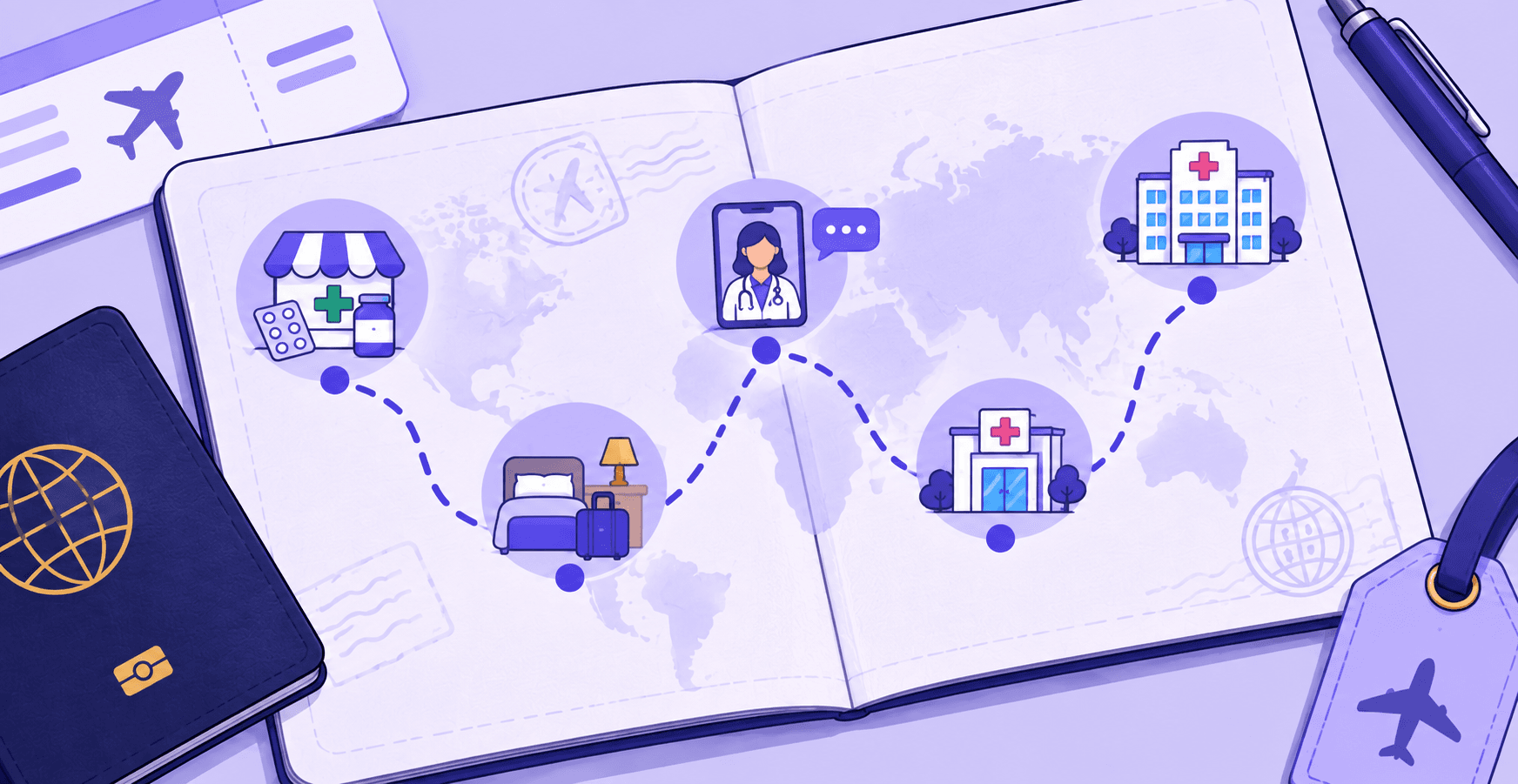
You have five realistic options when you need a doctor abroad: a local pharmacy, a hotel or resort doctor, a walk-in clinic or local GP, a hospital emergency department, or a video consultation. For anything sudden and severe, go straight to emergency care and call the local emergency number. For everything else, the right choice usually comes down to how quickly you need an answer and whether you can be assessed without being examined in person.
Worth knowing
- A pharmacy is the fastest route for minor problems, but what a pharmacist can hand over without a prescription differs from country to country.
- A video consultation suits problems that can be assessed by conversation and by looking: stomach upsets, rashes, urinary symptoms, coughs, medication questions.
- In-person care wins when something needs to be physically examined, imaged, swabbed or stitched.
- A UK Global Health Insurance Card gets you state healthcare on the same basis as a local resident, which is not the same as free care. The NHS states that you may have to pay for treatment you would get free at home if a local resident would also pay.
- In the EU, 112 reaches an ambulance, the fire brigade or the police, free of charge, from a fixed line or a mobile.
In this guide
What are your options if you get sick abroad?
Every route below is real and every one is the right answer sometimes. The differences that actually matter to a traveller are how long it takes, whether you have to leave where you are, and whether the person you speak to can do anything about your problem.
| Option | Good for | The catch |
|---|---|---|
| Local pharmacy | Minor, familiar problems. Advice in minutes, often within walking distance. | What a pharmacist can supply without a prescription varies by country. The medicine you buy over the counter at home may be prescription-only where you are, or sold under a name you do not recognise. |
| Hotel or resort doctor | Convenience when you are too unwell to travel across town. | Availability and cost are set by the property, not by you, and there may be nobody on site out of hours. |
| Local clinic or GP | Anything needing hands-on examination, a swab, a test or a dressing. | You have to find one, get there, and get through it in a language you may not share. Registration rules for visitors differ everywhere. |
| Hospital emergency department | Anything sudden, severe or frightening. This is the right choice when in doubt. | Long waits for problems that are not emergencies, and in many countries payment or a deposit is expected before treatment. |
| Video consultation | Problems a doctor can assess by talking to you and looking: stomach upsets, rashes, urinary symptoms, coughs, ear pain, medication questions. | No physical examination, no imaging, no tests. If your problem needs any of those, the consultation ends by telling you where to go. |
Pharmacy rules really do differ. In France, for example, a trained pharmacist can now run a rapid test at the counter and supply antibiotics if it is positive, but only for a sore throat in people aged 10 and over and for simple cystitis in women aged 16 to 65, and the pharmacist can decline if, for example, you do not speak enough French to give your medical details. A duty pharmacy, the pharmacie de garde, covers nights, Sundays and public holidays. Our guide to seeing a doctor in France sets out which route fits which situation there.
How do you decide which one to use?
Two questions get you to an answer quickly.
- Is this sudden and severe? Chest pain, difficulty breathing, a severe head injury, heavy bleeding, a stiff neck with sensitivity to light, confusion, or symptoms that are getting worse fast. If yes, stop reading and get emergency help.
- Does someone need to physically examine me? A suspected fracture, a wound that may need closing, severe or localised abdominal pain, anything that needs a scan or a blood test. If yes, you need to be seen in person, and a video call is still useful for working out where to go.
If both answers are no, you are in the territory where a video consultation is usually the shortest path between feeling unwell and knowing what to do about it.
What can a doctor actually do over video?
More than most people expect, and less than a clinic. A video consultation is a real consultation: history, symptoms, what you have already tried, what you are taking, and a look at anything visible.
A doctor on a video call can usually:
- Work out how likely it is that your symptoms are something serious.
- Tell you what to do next, and how long to expect it to take.
- Explain which over-the-counter options are appropriate for your situation.
- Tell you clearly when to stop self-treating and get seen in person, and what to look out for in the meantime.
- Consider a prescription where that is clinically appropriate and local rules allow. Whether one can be issued and then dispensed depends on the medicine and the country you are in.
What it cannot do is put hands on you. No examination of your abdomen, no chest listened to, no swabs, no imaging, no bloods. That is a real limit, not a technicality, and it is exactly why a good video consultation sometimes ends with the doctor sending you somewhere else.
What if it is an emergency?
Anywhere in the EU, 112 reaches an ambulance, the fire brigade or the police, free of charge, from a fixed line or a mobile. It works alongside national emergency numbers rather than replacing them, and some countries outside the EU use it too. If you are travelling further afield, look up the local number on arrival and put it in your phone. It takes ten seconds and it is the one piece of travel admin you will be glad you did.
Will insurance or a health card pay for it?
Assume you are paying something, and check the detail before you need it rather than after.
For UK travellers, a Global Health Insurance Card gives access to necessary state healthcare in the EEA and some other countries on the same basis as a resident of that country. The NHS is explicit that this is not the same as free care: it may be free, or it may require a payment equivalent to what a local resident would pay, and you may be charged for treatment you would get free on the NHS. It does not cover treatment in a private facility, medical repatriation, or mountain rescue, and the NHS states plainly that it is not a replacement for travel insurance.
UK government guidance on foreign travel insurance makes the same point from the other side. It gives the example of a broken leg in Spain needing hospital treatment and possible repatriation, and a stomach bug in the USA needing hospital admission, and states that the government does not pay these bills. If you are uninsured, they are yours.
What should you have ready before you speak to a doctor?
A consultation goes faster and gets further when you can answer these without hunting. None of it is complicated, but it is much harder to assemble while you feel terrible. The longer version, including what to say about your medical history and how to describe a symptom usefully, is in a traveller's checklist for seeing a doctor abroad.
- Where you are, specifically. The country and the city or region.
- When the symptoms started, and whether they are getting better, worse or staying put.
- Your temperature, if you can take it, and anything else you can measure rather than estimate.
- Any medicines you take regularly, using the generic name on the packet rather than the brand, plus anything you have taken in the last day or two.
- Allergies, and any condition a doctor would want to know about.
- What you have eaten or drunk that is out of the ordinary, and where.
What if the problem is a prescription rather than a symptom?
Running out of your own medication, or losing it, is a different problem from getting ill, and it has different answers. The rules for carrying medicines across borders, replacing them abroad, and why the brand name you know may not exist where you are, are covered separately in our guide to prescriptions abroad.
If the problem is a stomach upset specifically, which is a common way for a trip to get interrupted, what to do in the first day of food poisoning covers the practical version, including the symptoms that mean you should stop managing it yourself.
And if you are not sure whether your particular complaint is one a video call can do anything useful with, five common travel illnesses a video doctor can help with works through the usual suspects and where each one runs out of road.
Common questions
Can I see a doctor abroad without local health insurance?
Yes. Private clinics and video consultations do not depend on local insurance, and emergency departments will treat an emergency regardless. What differs is who pays and when. In many countries payment or a deposit is expected before non-emergency treatment, so check what your travel insurance covers before you travel.
Will a doctor abroad speak English?
In tourist areas, often. Outside them, less reliably, and a consultation about your health is a bad place to be guessing at vocabulary. This is one of the clearest advantages of a video consultation: you can arrange to speak with an English-speaking doctor rather than hoping the nearest clinic has one on shift.
Is a video consultation good enough for a real medical problem?
For a large share of the problems that interrupt trips, yes. Stomach upsets, rashes, urinary symptoms, coughs and ear pain can usually be assessed through history and observation. For anything needing physical examination, imaging or tests, a video consultation is still useful for deciding where to go, but it is not a substitute for being seen.
What if I am in the middle of nowhere with poor signal?
Find the strongest connection you can before you start, and know your fallback. If a call is not going to be possible, identify the nearest pharmacy or clinic instead, and use the local emergency number if the situation is severe.
Should I just go to the emergency department to be safe?
If your symptoms are sudden or severe, yes, without hesitation. If they are not, an emergency department is usually the slowest option and in many countries the most expensive, and non-urgent cases are seen last. That is the case for sorting out first whether you actually need one.
Sources
- Apply for a free UK Global Health Insurance Card (GHIC)NHSWhat a GHIC covers, that care is provided on the same basis as a local resident rather than free, and that it is not a replacement for travel insurance.
- Foreign travel insuranceGOV.UKThat the UK government does not pay medical bills abroad, and that a GHIC or EHIC is not an alternative to travel insurance.
- 112, the European emergency numberEuropean CommissionThat 112 is free of charge, works from fixed and mobile phones everywhere in the EU, reaches an ambulance, the fire brigade or the police, and operates alongside national numbers.
- Medicines and travelNaTHNaC, National Travel Health Network and CentreThat the legal status of a medicine can differ outside the UK, and the advice to carry a prescriber's letter using generic medicine names.
- Dans quels cas un pharmacien peut-il délivrer un antibiotique sans ordonnance ?Service-Public.fr, Direction de l'information légale et administrativeThat in France a trained pharmacist may run a rapid test for sore throat (age 10 and over) or simple cystitis (women aged 16 to 65) and dispense antibiotics without a prescription if it is positive, after checking exclusion criteria, which include insufficient medical information, for example not speaking French.
- Pharmacies de garde de nuits, dimanches et jours fériésAgence régionale de santé Nouvelle-AquitaineThat the French duty-pharmacy rota, the pharmacie de garde, covers nights, Sundays and public holidays.
Keep reading
 Getting careVideo or in person: which care do you actually need?What each one can and cannot do, the signs that rule video out entirely, and how to prepare for either.
 SymptomsFood poisoning on holiday: what to do firstThe first few hours, what actually helps, and the symptoms that mean it is time to involve a doctor.
 MedicationPrescriptions abroad: what travellers need to knowWhat carries across borders, what does not, and what to do when your medication is 3,000 miles from your bathroom cabinet.
 Getting careHow to see a doctor online in Belgium, in EnglishThree official languages, a system built around a family doctor you do not have, and a waiting list you are not on. What to do when you feel unwell in Belgium and want to be understood.