
Getting care
Video or in person: which care do you actually need?
What each one can and cannot do, the signs that rule video out entirely, and how to prepare for either.

The short answer
A video consultation and an in-person visit are not competing versions of the same thing. Video is a conversation and a visual assessment: good for symptoms a doctor can evaluate by talking to you and looking at you, and good for working out how urgent your situation is. In-person care is the only option when someone needs to physically examine you, run a test, take an image, or carry out a procedure. For anything that could be an emergency, skip both and contact local emergency services.
Worth knowing
- Video suits non-emergency problems: colds and sore throats, rashes, insect bites, mild digestive upsets, questions about over-the-counter options.
- A video call cannot listen to your chest, feel your abdomen, look inside your ears, take blood, image you, stitch you or vaccinate you.
- One of video's most useful jobs is triage: telling you whether you need local care at all, and if so, what kind.
- NHS guidance on stroke is to remember face, arms, speech and time to call emergency services. Those signs, and heart-attack signs, mean emergency care, not a consultation.
- If the doctor on the call tells you to be seen in person, that is the consultation working, not failing.
In this guide
You wake up to the view you booked the trip for and feel terrible. The real question is not how ill you are. It is what to do in the next hour, in a country whose healthcare system you have never used.
What is a video consultation?
A private, real-time conversation with a doctor over the camera on your phone, laptop or tablet. It is a proper medical appointment, held from wherever you have a stable connection: a hotel room, an apartment, a quiet corner of a cafe.
The point of it is to describe your symptoms, get medical guidance, and leave knowing what to do next, in a language you actually speak. It brings the doctor to you instead of sending you to find one.
What is an in-person visit?
The familiar thing: physically going to a doctor's office, a walk-in clinic, an urgent care centre or a hospital to be assessed face to face.
Abroad, that also means working out local transport while feeling awful, picking the right kind of facility, and handling reception and possibly the consultation itself across a language gap. Wait times and costs are usually unknown until you arrive. Whether you pay, and how much, depends on the country and on what you are carrying: a UK Global Health Insurance Card, for instance, gets you state care on the same basis as a local resident, and the NHS is explicit that this is not the same as free care.
When is video a good first step?
Think of it as triage with a qualified person on the other end, rather than a lesser version of a clinic.
Common, non-emergency travel complaints
A cold or flu coming on, a sore throat, a new skin rash, a reaction to an insect bite, mild digestive trouble from unfamiliar food, or a question about which over-the-counter option fits your situation. These are the things a doctor can usually assess through history and observation.
When you need the conversation in English
Medicine runs on nuance. Describing symptoms, or understanding instructions, across a language barrier is where things get lost. Speaking with an English-speaking doctor means you can explain what is actually happening and be confident you understood the answer. If you do end up in a clinic without a shared language, how to explain your symptoms to a doctor abroad sets out what to write down and how far to trust a translation app.
When the day matters
Finding a clinic, getting there, waiting, and getting back can absorb most of a day you will not get again. A consultation you take from your room does not.
When you do not know whether you need a clinic at all
This is the one travellers underrate. A doctor can tell you how urgent your situation is and what kind of local care to look for, which either saves you an unnecessary trip to a busy emergency department or tells you to go now and not wait.
When do you need in-person care?
Video has hard limits, and being straight about them is the point of this article.
Anything that could be an emergency
The NHS also notes that stroke symptoms sometimes stop after a short time, and that you should still get help straight away if they do. Anywhere in the EU, 112 reaches an ambulance free of charge from a fixed line or a mobile. Elsewhere, look up the local number when you arrive rather than when you need it.
When someone needs to physically examine you
Doctors use their hands and their instruments for a reason. Listening to your chest, feeling your abdomen for tenderness, looking inside your ears or throat with a light, checking reflexes: none of that happens over a camera. If your problem needs any of it, you need to be in the room.
When you need a test, an image or a procedure
A video call cannot take blood, run an X-ray or an ultrasound, put in stitches, or give you a vaccine. If there is a realistic chance your situation needs lab work, imaging or a physical procedure, in-person care is the only route.
When the doctor on the call says so
A doctor's first duty is your safety, not the convenience of the format. If they decide you need a physical examination or more urgent attention, they will say so and tell you what to look for. That is the consultation doing its job.
The two side by side
| Video consultation | In-person visit | |
|---|---|---|
| Best for | Non-emergency problems, medical guidance, follow-up questions, deciding what to do next. | Emergencies, anything needing a physical examination, tests, imaging or a procedure. |
| Getting there | No travel. From wherever you have a stable connection. | Travel while unwell, finding the right facility, unknown waiting time. |
| Language | An English-speaking doctor. | A language gap is possible with reception and with the clinician. |
| Examination | Conversation and what can be seen on camera. | Full hands-on examination. |
| Tests and procedures | None. | Bloods, imaging, stitches, vaccinations. |
| Its real strength | Working out how urgent this is, and what kind of care you need. | Doing the things that require being physically present. |
How do you prepare for either one?
For a video consultation
- A quiet, private spot with enough light that the doctor can actually see you.
- Check the connection before you start, and know your fallback if it drops.
- A short timeline written down: when symptoms started, whether they are improving, and what you have taken, with doses.
- Your passport or ID nearby, since you may need to confirm who you are.
For a clinic visit abroad
- Passport, and your travel insurance policy number and assistance line.
- The address of where you are staying, written down rather than remembered.
- Your key symptoms written in the local language using a translation app, as a backup rather than a plan.
- Expect to pay something, and ask about cost before treatment where you can.
So which one do you choose?
There is no better option in the abstract, only the one that fits your symptoms. For non-emergency problems, starting with a video consultation is a reasonable and low-cost way to find out where you stand. Pomodoc connects travellers with English-speaking doctors by video for exactly that.
Sometimes the outcome of that call is being told to go to a local clinic. That is not the service failing. The point of a video consultation is not to replace in-person care; it is to help you use it well when you are a long way from your own doctor.
This page is about what each mode can establish. If your question is the practical one instead, what a walk-in clinic abroad actually costs you in travel, queueing, language and an unpredictable bill, video doctor or walk-in clinic weighs those directly.
If you would rather compare every route rather than these two, the five ways to see a doctor abroad covers pharmacies, hotel doctors, clinics and emergency departments alongside video. If the problem is specifically a stomach upset, what to do in the first day of food poisoning is the more useful page. And for medication questions, our guide to prescriptions abroad explains what carries across borders.
Common questions
What if my internet connection is poor while traveling?
Find the strongest connection you can before you start: a lobby or a cafe often beats a room at the back of a hotel. Know your fallback too. If a call is not going to be possible at all, a local pharmacy or clinic is the alternative, and for anything severe you should be contacting emergency services rather than troubleshooting Wi-Fi.
Can a doctor on a video call prescribe medication abroad?
Sometimes, and the conditions are real rather than legal hedging. Prescribing is regulated country by country, so whether a prescription can be issued and then actually dispensed near you depends on the medicine and the country. A doctor can also talk through which over-the-counter options are appropriate for your situation. For Pomodoc specifically: Prescriptions when local rules allow. Your doctor may issue one when it’s clinically appropriate and local rules permit. There is more detail in our guide to prescriptions abroad.
Is a video consultation private and secure?
Your consultation is a medical appointment and is treated as confidential. Pomodoc is operated by Air Doctor Ltd., which is the data controller for the information you provide, and its privacy policy names the measures used to reduce the risk of unauthorised access: TLS 1.2+ encryption, secure authentication and session controls. That policy is also straightforward about the limit, and that is the part worth reading. It states that such measures do not make information security absolute. It is also where to look for what is and is not shared with third parties, why your full card number is never received or stored because payment runs through payment providers, and how long information is kept. Read the privacy policy for the detail.
Will my travel insurance cover a video consultation?
Check your policy, and check it before you need it rather than after. Cover for telemedicine varies between insurers and between policies, and so does the reimbursement process. UK government guidance is clear that you should take out appropriate travel insurance before you go and that a health card is not an alternative to it.
Is a video consultation as good as seeing a doctor in person?
For some problems, yes. For others, no, and no honest service will tell you otherwise. Anything that needs a physical examination, a test, an image or a procedure needs a clinic. What video does well is assess what can be assessed by conversation and observation, and tell you which of those two situations you are in.
What happens if the doctor says I need to be seen in person?
They will explain what kind of care to look for and how urgently. Treat that as the useful outcome it is: you now know what you are dealing with and where to go, which is considerably better than guessing from a hotel room.
Sources
- Stroke: symptomsNHSThe face, arms, speech and time wording, the individual stroke signs, and the guidance to get help straight away even if symptoms stop.
- Heart attackNHSThe heart-attack signs that require emergency services: chest pain that feels tight or squeezing, pain spreading to the arms, neck or jaw, severe difficulty breathing, pale, blue or grey lips or skin, and someone not responding normally.
- Diarrhoea and vomitingNHSThe further emergency signs listed here: sudden severe headache, sudden severe abdominal pain, a stiff neck with sensitivity to light, and confusion.
- 112, the European emergency numberEuropean CommissionThat 112 reaches an ambulance free of charge from a fixed line or a mobile anywhere in the EU.
- Apply for a free UK Global Health Insurance Card (GHIC)NHSThat a GHIC provides state healthcare on the same basis as a local resident rather than free care, and that it is not a replacement for travel insurance.
- Foreign travel insuranceGOV.UKThe advice to take out appropriate travel insurance before travelling, and that a health card is not an alternative to it.
Keep reading
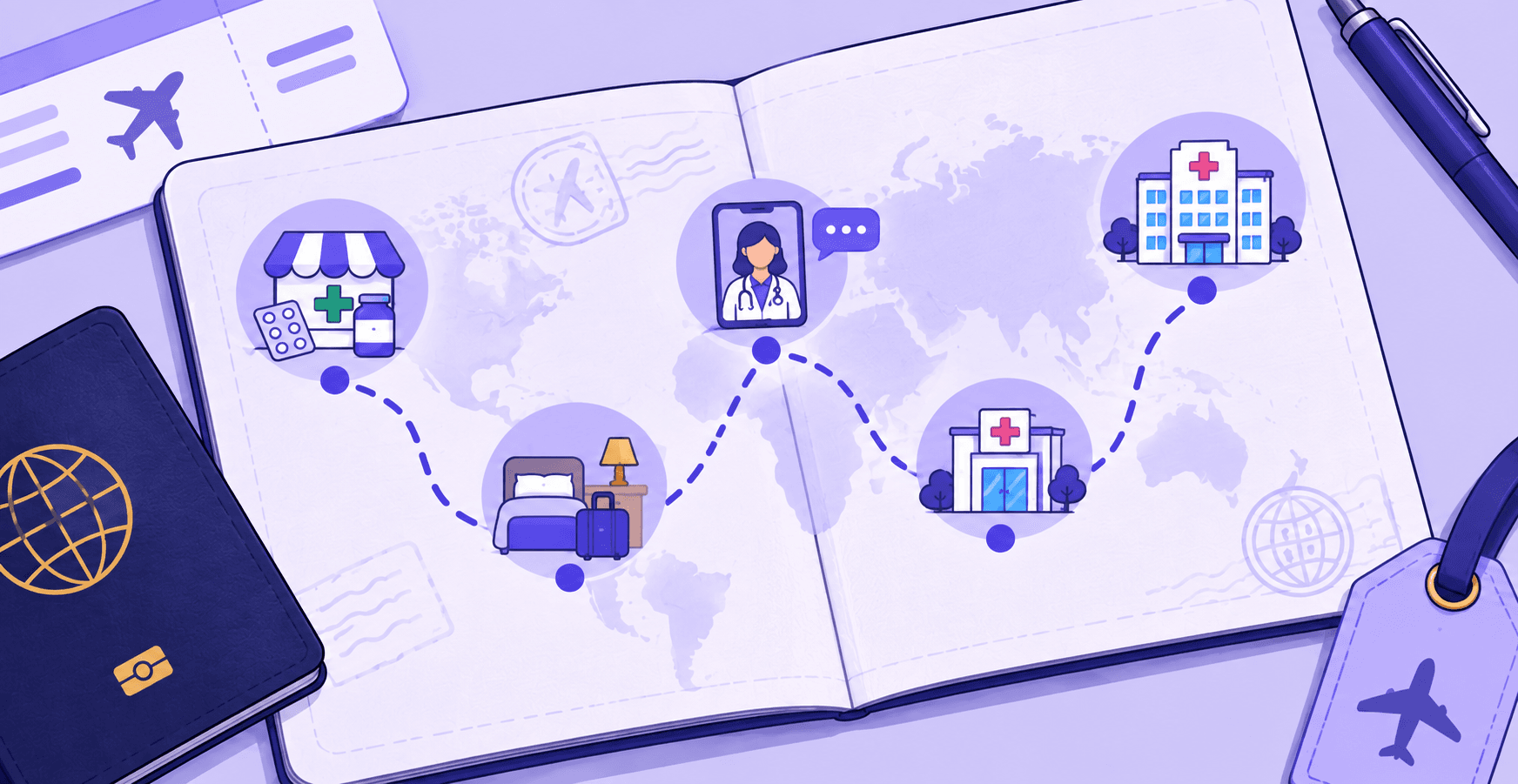 Getting careHow to see a doctor online while you are abroadSeeing a doctor by video is one of five realistic options. What each one costs you in time, and how to pick without losing the afternoon.
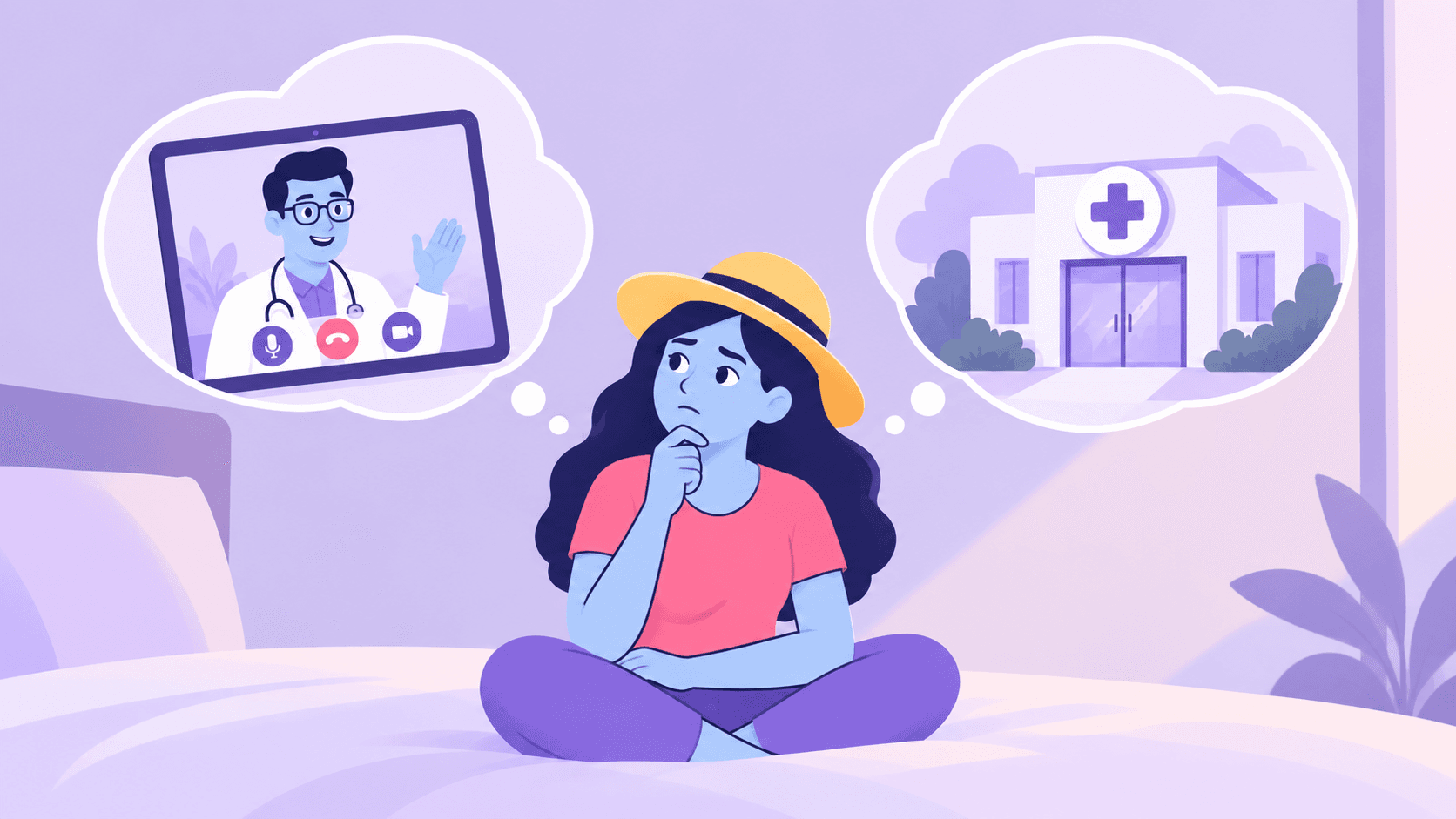 Getting careVideo doctor or walk-in clinic: which one do you need?One means getting dressed, finding a clinic and queueing in a language you may not speak. The other does not. Here is how to tell which your symptoms actually need.
 SymptomsFood poisoning on holiday: what to do firstThe first few hours, what actually helps, and the symptoms that mean it is time to involve a doctor.