
Getting care
How to see a doctor online in Belgium, in English
Three official languages, a system built around a family doctor you do not have, and a waiting list you are not on. What to do when you feel unwell in Belgium and want to be understood.
The short answer
Yes. A video consultation is the most direct route, because it settles the language before you book rather than when the doctor walks in: you describe what is happening in English and speak to a doctor licensed to treat you in Belgium, from wherever you are staying. The alternatives are your embassy's list of local doctors, your travel insurer's assistance line, and asking your hotel. What none of them changes is that Belgian general practice is built around a registered family doctor, and as a visitor you do not have one. For an emergency, call 112 and do not spend time looking for an English speaker first.
Worth knowing
- Belgium has three official languages, Dutch, French and German, and which one you meet depends on where in the country you are.
- General practice is organised around a registered family doctor, the huisarts or medecin traitant. A visitor has no registration, which is what makes a same-week appointment hard rather than the language.
- A video consultation needs no Belgian insurance and no EHIC or GHIC card. You pay by card and the whole thing happens in English.
- A doctor can issue a private prescription that any Belgian pharmacy can fill. You pay the full price for the medicine and claim it back if your policy covers it.
- 112 is the emergency number across Belgium and across the EU. For anything needing hands-on examination, go to a hospital emergency department.
In this guide
You are in Belgium. Perhaps a waffle in Brussels, the canals at Bruges, the guild houses in Ghent, or a long weekend somewhere in the Ardennes. It is a small country that rewards a slow trip, and then somewhere between the second and third day you wake up feeling wrong.
The illness is the first problem. The second arrives about a second later, and for most visitors it is the larger one: how do I see a doctor here, and how do I explain any of this if I do not speak the language? Belgium adds its own wrinkle to that, because there is no single answer to which language it is.
Why seeing a doctor in Belgium is harder than it looks
Belgian healthcare is good. It is also organised for residents, which is a different thing from being organised for you, and three parts of it are worth knowing before you start ringing round.
Three official languages, and no way to predict which one
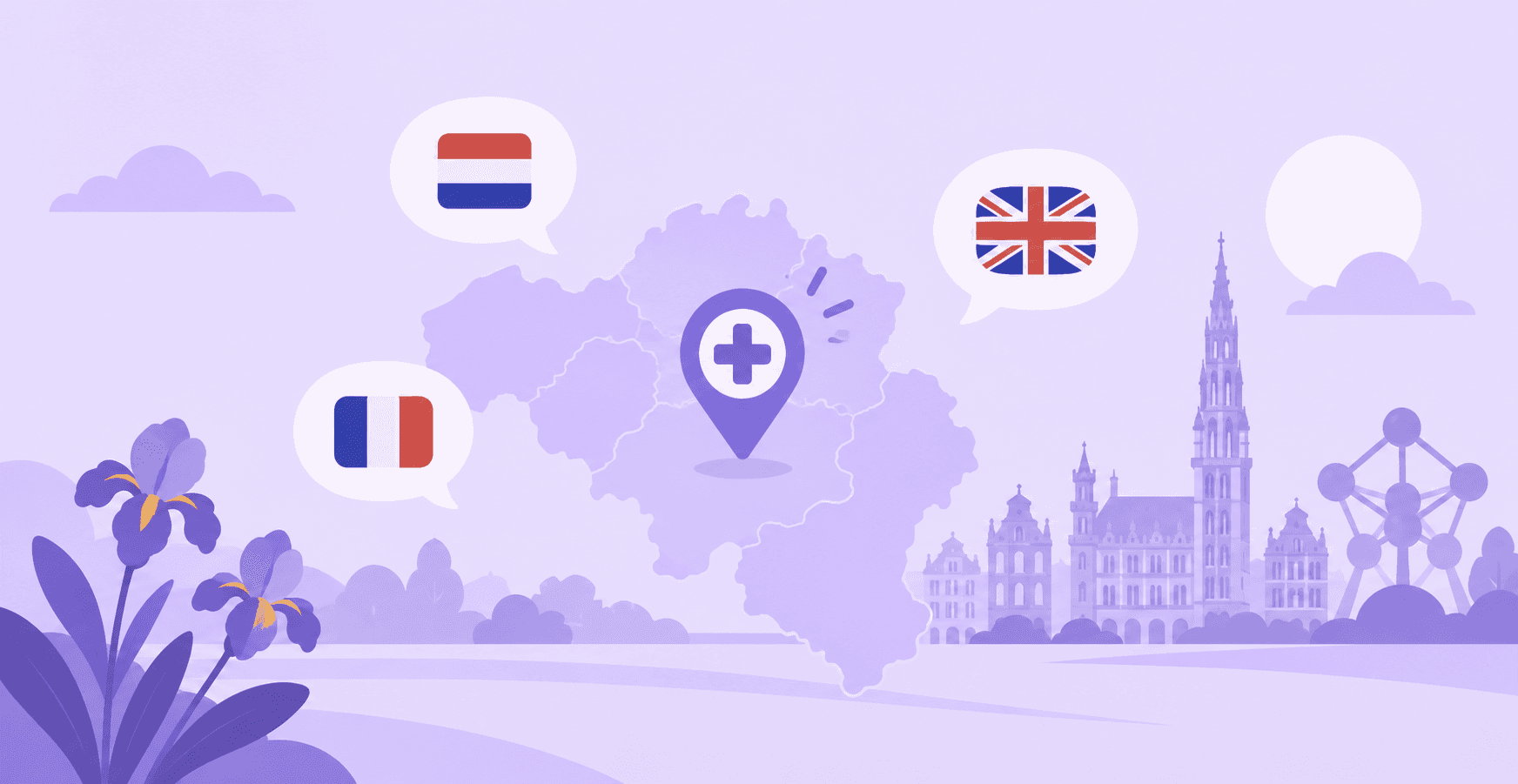
Dutch, French and German are all official. Flanders in the north is Dutch-speaking, Wallonia in the south is French-speaking, Brussels is officially bilingual, and a small German-speaking community sits in the east near the border. A practice that answers the phone in Dutch or French is under no obligation to switch to English, and the receptionist speaking some English tells you nothing about the doctor you will actually see.
For most things that would be a minor inconvenience. For describing a symptom, a drug allergy or a medical history it is not: this is the one conversation where being approximately understood is not good enough.
The system is built around a family doctor you do not have
Belgian general practice runs on the huisarts in Dutch, the medecin traitant in French: a family doctor you are registered with, who holds your record and is your route into everything else. Residents have one. You do not, and that is the real obstacle rather than the language. It is why a practice can be perfectly willing to help and still not have a slot for a one-off patient this week.
An EHIC or GHIC card helps with the cost of state-provided care if you are eligible, and it is worth carrying. What it does not do is find you an appointment, shorten a wait, or produce a doctor who speaks English.
Getting seen quickly, as a visitor
Practices are busy with their own registered patients, and a clinic taking new patients for a single appointment is not something you can count on finding on the day. For something that is uncomfortable rather than dangerous, a sore throat, a rash, a urinary infection, a stomach upset that will not settle, the honest position is that you may spend more of the day arranging care than receiving it.
Seeing a doctor online, in English, from anywhere in Belgium
Pomodoc exists for exactly this gap. It connects you by video with an English-speaking doctor licensed to treat you in Belgium, which removes both problems at once: you are not searching for a practice that will take you, and you are not hoping the doctor speaks your language.
Built for a visitor, not for the Belgian system
There is no registration with a huisarts, no Belgian insurance and no EHIC card involved. The service is in English from the first screen to the end of the consultation, and it reaches you wherever you are staying, from a hotel in Antwerp to a gite in the Ardennes to the coast at Ostend. All it needs is a connection good enough for a video call.
What actually happens
- Tell us where you are and what is wrongOne short form: the country you are in, what is happening, and how to reach you. It is in English and it takes a couple of minutes.
- Choose from your doctor optionsYour available appointment options come back to you, and you pick the one that suits you. €40 for a video consultation with a doctor. Fixed price. No surprises.
- Speak to the doctor by videoAt the time you booked, you talk it through with an English-speaking doctor licensed to treat you in Belgium, and finish with a clear plan for what to do next.
What that means for your trip
- No local registration and no EHIC card needed. You pay by card for the consultation itself.
- No clinic to find and no waiting room to sit in. Which matters most on the day you least feel like crossing a city.
- English throughout. Nothing gets lost between your symptoms and the person assessing them.
- It reaches the whole country. Brussels, Bruges, Antwerp, Ghent, the Ardennes, the coast.
- A price you know in advance. €40 per consultation, which is the part of Belgian healthcare that is otherwise hardest to predict as a visitor.
Video care or in-person care in Belgium
A video consultation is a first step, not a replacement for a hospital. Knowing which one you need is the single most useful thing on this page.
What an online doctor can help with
The everyday illnesses that ruin a trip without threatening one. Colds and flu, sore throats, ear pain, skin rashes, insect bites, mild digestive upsets, urinary infections, questions about medication you already take, and the very common case of not knowing whether what you have is serious. What a video consultation actually is covers what to expect on the call itself.
When you need to be seen in person in Belgium
For an emergency, call 112. It is the emergency number across Belgium and across the European Union, free of charge from mobile and fixed phones, and the European Commission says that in many EU countries operators can answer in English as well as in their national language.
For anything that needs hands and equipment rather than eyes, a suspected fracture, a wound that needs closing, a test, an internal examination, go to a hospital emergency department. The signs are spoedgevallen in Dutch and urgences in French. A video doctor can and will tell you when that is the right call, which is often the most valuable thing a consultation produces. Video or in person: which care do you actually need? sets the boundary out properly.
| Pomodoc, by video | A Belgian practice, in person | |
|---|---|---|
| Language | English, settled before you book | Dutch, French or German. English is likely in the cities and not assured |
| Getting an appointment | Book from where you are, no registration | Practices prioritise their own registered patients |
| Paperwork | A payment card | Often local registration, or an EHIC or GHIC card |
| Cost | €40, fixed | Varies, and not always clear before you go |
| Where it works | Anywhere in Belgium with a connection | You travel to the practice |
| What it cannot do | Examine you, run a test, treat an emergency | Nothing: this is the route for anything physical |
Prescriptions and pharmacies in Belgium
If the doctor judges it clinically appropriate, and local rules allow it, they can issue a private prescription. In Belgium that is an ordonnance or a voorschrift, and you take it to a pharmacy, the pharmacie or apotheek, to collect the medicine.
Expect to pay the full price for the medicine rather than a subsidised resident's price, keep the receipt, and claim it back afterwards if your travel policy covers it. A prescription is never automatic: it depends on what is actually wrong and on what a doctor is permitted to prescribe where you are. Prescriptions abroad explains how that works across borders, and telemedicine without insurance covers paying directly and claiming later.
In short
- Yes, you can see an English-speaking doctor online in Belgium. A video consultation is the fastest of the routes, because the language is settled before you book.
- The barrier is registration as much as language. Belgian general practice runs on a family doctor you do not have.
- No EHIC card is needed for a video consultation. It is €40, paid by card.
- Prescriptions go to any Belgian pharmacy. You pay in full and claim back if your policy covers it.
- Emergencies: 112. Anything physical: a hospital emergency department, spoedgevallen or urgences.
Common questions
Can an online doctor in Belgium give me a prescription?
Where it is clinically appropriate and local rules permit, yes. The doctor can issue a private prescription that any Belgian pharmacy will fill. You pay the full price for the medicine rather than the subsidised rate a registered resident pays, so keep the receipt and submit it to your travel insurer if your policy covers medical expenses. Some medicines cannot be prescribed by video at all, which is a rule about the medicine and the country rather than about the consultation.
Can I get a doctor’s note for my employer?
For appropriate conditions, the consulting doctor can provide a note confirming the consultation and their opinion, which is what a Belgian certificat medical or ziektebriefje does. Whether your employer accepts it is a question for your employer, and it is worth checking their requirements before you need one rather than after.
Do I need an EHIC or GHIC card?
Not for a video consultation, which you pay for by card. Carry one anyway if you are eligible: it helps with the cost of state-provided care if you end up in a Belgian hospital, which is exactly the situation nobody plans for. It is worth being clear about what it is, though. An EHIC or GHIC is a cost-sharing arrangement, not an appointment, not a translator and not travel insurance.
Will the doctor be able to treat me in Belgium specifically?
Pomodoc connects you with a doctor licensed to treat you in the country you are physically in, which for this article means Belgium. That detail decides whether the advice is usable where you are standing. A prescription you already hold may still help: under EU rules a prescription issued by a doctor in one EU country is valid in the others, although the medicine may be unavailable or sold under another name, and that rule covers prescriptions from EU countries only. You tell Pomodoc which country you are in when you start, and availability is confirmed for that country as part of booking.
When should I go to a hospital in Belgium instead of a video consultation?
Go to a hospital emergency department, signposted spoedgevallen in Dutch and urgences in French, for anything that needs hands or equipment rather than eyes: a suspected fracture, a wound that needs closing, a scan, a blood test or an internal examination. For a medical emergency call 112, which is the emergency number across Belgium and the rest of the European Union. A video consultation suits everyday problems such as colds and flu, sore throats, skin rashes, mild digestive upsets and urinary infections, and the doctor will tell you when what you have belongs in the first group instead.
What if it is the middle of the night?
For an emergency in Belgium, call 112 at any hour. For something urgent but not dangerous, your accommodation or your travel insurer's assistance line can tell you which out-of-hours service covers where you are staying. You can start a Pomodoc request and see the available doctor options and appointment times before deciding whether you need to travel anywhere.
Keep reading
 Getting careHow to see a doctor by video abroad, and be understoodBeing ill abroad is two problems at once, and the language barrier is the one nobody plans for. Six ways to be understood by a doctor, starting with a video consultation, ranked by how fast they work.
 Getting careHow to see a doctor online while you are abroadSeeing a doctor by video is one of five realistic options. What each one costs you in time, and how to pick without losing the afternoon.
 Getting careVideo or in person: which care do you actually need?What each one can and cannot do, the signs that rule video out entirely, and how to prepare for either.