
Getting care
How to see a doctor online in Egypt, in English
Seeing a doctor online in Egypt turns less on language than on where you are when you need one, and whether the doctor the hotel offers to send up is the right first move.
The short answer
A video consultation is usually the quickest way to speak to a doctor in English in Egypt, and it works from a hotel room, a resort or anywhere with a stable connection. English itself is not the scarce part: private clinics in Cairo and the Red Sea resorts are used to international patients, and the FCDO publishes a list of medical providers where some staff speak English. What is worth knowing before you accept the first offer is that hotel doctors have been reported to overcharge for treatment and medicines, and that pharmacies outside hotels are often cheaper. For anything life threatening, call 123 for an ambulance rather than booking anything.
Worth knowing
- For a non-emergency, a video consultation gets you a doctor in English without leaving your room or working out local transport.
- The emergency number in Egypt is 123 for an ambulance. That call comes before any online option.
- The hotel will often offer to send a doctor up. Hotel doctors have been reported to overcharge, so it is worth knowing your alternatives before you say yes.
- Pharmacies outside hotels often supply the same medication at lower prices.
- Some medicines that are ordinary at home, prescription and over the counter alike, are controlled substances in Egypt. Check before you rely on being able to buy one.
In this guide
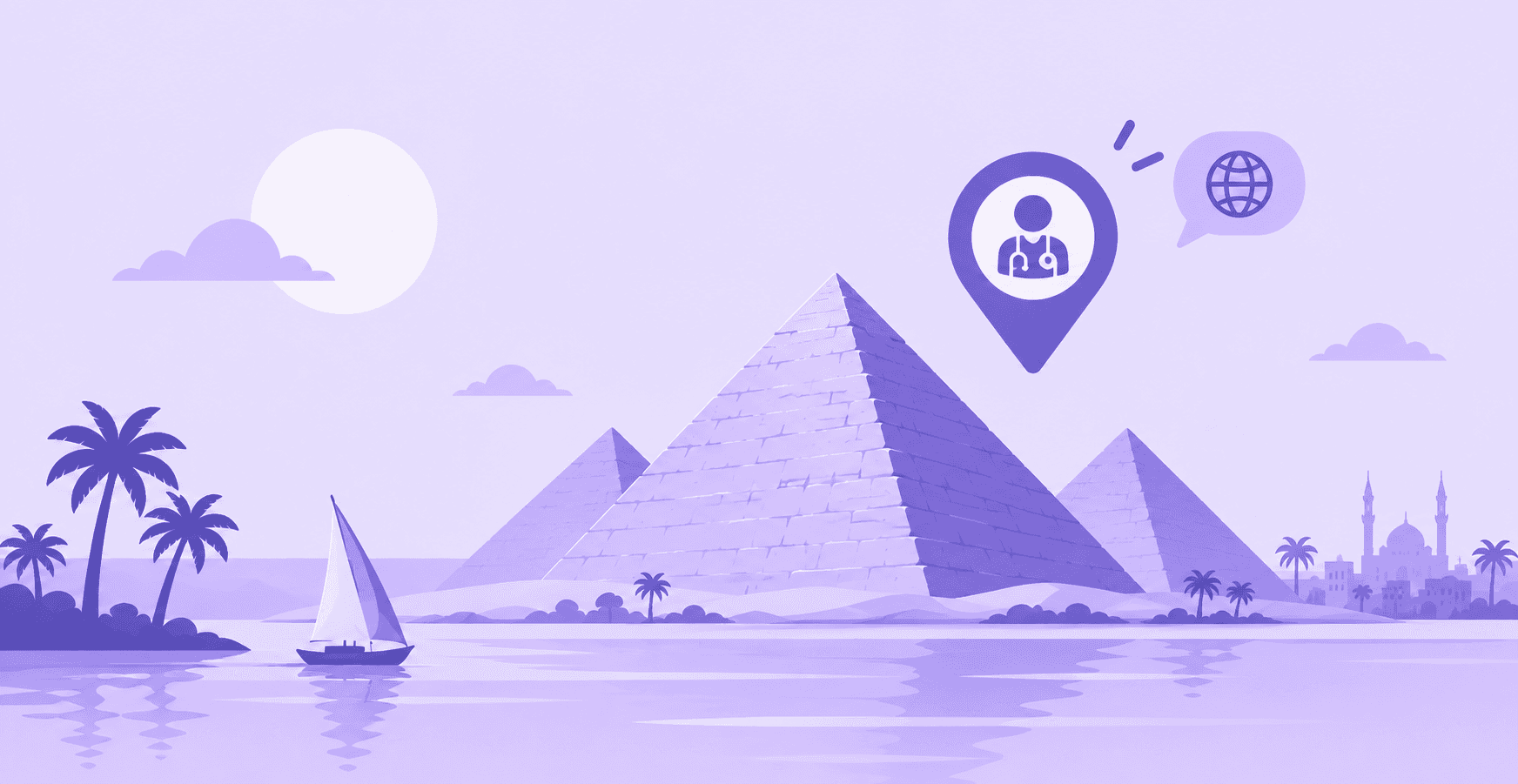
Standing in front of the pyramids or drifting down the Nile, you are somewhere you have wanted to be for years. Waking up with a fever in a Cairo hotel, or a stomach that has turned on you in Luxor, is the other side of the same trip, and it feels a long way from home.
The illness is rarely the hard part. The hard part is working out who to call, from where, in what language, and whether the thing you have is worth the effort of finding a clinic at all.
In Egypt the answer to that turns less on language than you would expect, and more on geography. This article covers what your options actually are, which one fits where you are standing, and when none of them is the right answer because you need an ambulance.
Why a video consultation is a sensible first move in Egypt
Because it removes the two obstacles that have nothing to do with medicine. You do not have to find a clinic, and you do not have to explain yourself twice.
It works from where you already are
This is the Egypt-specific part, and it is the reason this page exists. A great deal of Egyptian travel happens away from the cities: a resort on the Red Sea, a boat between Luxor and Aswan, a few days in an oasis. In those places the nearest clinic you would actually choose can be a long transfer away, and the calculation is different from the one you would make in a European city where a walk-in is fifteen minutes on foot.
A consultation you can take from your cabin or your room does not remove the need for a clinic when you genuinely need one. What it does is tell you whether you need one at all, which is the expensive question when the answer involves a car and half a day.
What you get, and what you do not
Pomodoc connects you by video with an English-speaking doctor licensed to treat you in Egypt, for a fixed €40 per consultation. You describe what is happening, they ask about your history, and you talk it through in plain English.
What you leave with is an assessment and a plan. It is a consultation rather than a guaranteed diagnosis or a guaranteed prescription: some things cannot be settled without an examination, and the doctor will say so when that is the case. Being told clearly that you need to be seen is a useful outcome, not a failed one.
The doctor the hotel offers to send up
In a Red Sea resort or a Cairo hotel this is usually the first thing offered, and it is convenient in a way that is hard to argue with when you feel awful. It is still worth a moment's thought, because the FCDO records a specific problem with it: some hotel doctors have overcharged for treatment and medicines.
Two things follow from that, and neither is a reason to refuse care.
- Ask what the visit will cost before it happens, and ask whether it is billed to the room.
- Buy medicines at a pharmacy rather than through the hotel where you can. Pharmacies outside hotels will often supply the same medication at lower prices.
This is also the practical case for making the first conversation a video one. Knowing whether you need a doctor in the room, a pharmacy, or nothing at all puts you in a much better position when somebody is standing at your door with a bill.
When you need to be seen in person instead
A camera cannot press on your abdomen, listen to your chest, look inside your ear with an otoscope, or close a wound. Where the answer depends on one of those, in-person care is the answer, and the honest version of a video consultation is one that tells you so quickly.
Situations that generally need hands on assessment include severe abdominal pain that needs to be felt, a chest infection where someone has to listen to your lungs, a suspected ear infection, a cut that may need closing, and any injury you cannot use normally. There is more on where that line falls in what cannot be treated with telemedicine.
One more thing worth knowing before you go anywhere remote: the UK Foreign Office says access to specialised treatment for psychiatric illness is limited and may not be available outside Egypt's major cities, and more generally the nearest clinic you would choose can be a long transfer away. On a desert or Nile leg of a trip, the useful decision is usually made earlier rather than later.
Your options in Egypt, compared
| Option | Best for | Language | Worth knowing |
|---|---|---|---|
| A video consultation with Pomodoc | Non-emergency guidance, and working out whether you need a clinic: colds, rashes, mild stomach upset. | English-speaking doctors, licensed to treat you in Egypt. | Fixed €40 per consultation. Works from a resort, a hotel or a cabin with a stable connection. |
| A private or tourist clinic | Examinations, tests and procedures. Common in Cairo and in resort areas such as Sharm El Sheikh and Hurghada. | Often has English-speaking staff, and used to international patients. | Costs vary and are worth asking about up front. Frequently the right next step after a call rather than instead of one. |
| A doctor sent to your room by the hotel | Convenience when you cannot easily travel. | Usually English. | FCDO notes that some hotel doctors have overcharged for treatment and medicines. Agree the cost first, and buy medicines at a pharmacy. |
| The FCDO list of medical providers | Finding an in-person clinic other foreign nationals have used. | Some staff will speak English. | It is a list rather than an endorsement, and it does not promise quality or English throughout. |
| A hospital emergency department | Serious accidents and life-threatening symptoms. | Not the deciding factor here. | Call 123 for an ambulance. Urgency comes before language. |
Getting ready for the appointment, online or in person
A few minutes of preparation changes what you get out of a consultation, and it is easier to do before you feel worse. Have this to hand, on paper or in your phone:
- Your main symptoms, and when each of them started.
- Any conditions you already have, and any allergies.
- The names and doses of medicines you take regularly.
- Your travel insurance policy number and its assistance line, which is a different phone number from the insurer's office.
Medicines and prescriptions in Egypt
Pharmacies are straightforward to find and, as above, generally cheaper than buying through a hotel. The part that catches travellers out is what you are allowed to have.
Prescriptions when local rules allow. Your doctor may issue one when it’s clinically appropriate and local rules permit. Whether a given pharmacy can then dispense it is a separate question and practice varies, which is covered in our guide to prescriptions abroad. Where a prescription is not the answer, a doctor can tell you what to ask a pharmacist for instead.
In short
- English is not the scarce part. Private clinics in Cairo and the resorts are used to international patients, and FCDO lists providers where some staff speak English.
- Distance is the scarce part. On a cruise, in an oasis or at a Red Sea resort, a call first tells you whether the journey is necessary.
- 123 comes first. For anything life threatening, call for an ambulance rather than booking a consultation.
- Agree the cost of a room visit. Hotel doctors have been reported to overcharge, and pharmacies outside hotels are often cheaper.
- Check your medicines. Some ordinary ones are controlled substances in Egypt, whether or not they need a prescription at home.
Common questions
What is the emergency number in Egypt?
123, for an ambulance. It is worth saving in your phone on the day you arrive, along with your travel insurance assistance line. If someone has chest pain, difficulty breathing, signs of a stroke, heavy bleeding or will not wake properly, that call comes before any online option.
Can an online doctor give me a prescription in Egypt?
Sometimes, and it is not automatic. Your doctor may issue one when it’s clinically appropriate and local rules permit. Prescribing is regulated country by country, so the decision belongs to the doctor and to local rules rather than to the service. Separately, some medicines are controlled substances in Egypt even when they are sold over the counter at home, so a doctor may also be telling you what you cannot get here.
The hotel offered to send a doctor to my room. Should I say yes?
It can be the right call, particularly if you cannot easily travel, but ask what it will cost before it happens and whether it goes on the room bill. FCDO records that some hotel doctors in Egypt have overcharged for treatment and medicines, and that pharmacies outside hotels will often supply medication at lower prices. A video consultation first is a cheap way to find out whether you need anyone at your door.
What if I am on a Nile cruise or in an oasis with poor internet?
A video consultation needs a stable connection, and some of the best places in Egypt do not have one. If you cannot get a call to hold, ask your cruise staff, hotel or guide: they deal with this regularly and can point you at the nearest clinic or pharmacy that is actually reachable. For an emergency they should be your first call, because they can arrange transport as well as make the phone call.
It is a stomach problem, which is most of what I have read about Egypt. Call or clinic?
Usually a call, at least first. Stomach upsets are among the things a doctor can assess well by video, and the useful output is knowing which one you have and what the warning signs would be. We have pages on exactly that: food poisoning in Egypt if a particular meal is the suspect, and travellers' diarrhoea in Egypt if there is no obvious culprit.
Sources
- Egypt travel advice: healthUK Foreign, Commonwealth and Development OfficeThat the emergency number for an ambulance in Egypt is 123; that FCDO publishes a list of medical providers in Egypt where some staff will speak English; that some hotel doctors have overcharged for treatment and medicines; that pharmacies outside hotels will often supply medication at lower prices; that some prescribed and over-the-counter medicines may be controlled substances in Egypt and may need prior permission from Egypt's Ministry of Health; and that access to specialised treatment for psychiatric illness is limited and may not be available outside major cities.
Keep reading
 Getting careHow to see a doctor online in India, in EnglishPlenty of doctors in India speak excellent English. The difficulty is choosing one from a very large market while you feel awful, and knowing what a chemist will actually hand over.
 Getting careHow to see a doctor by video abroad, and be understoodBeing ill abroad is two problems at once, and the language barrier is the one nobody plans for. Six ways to be understood by a doctor, starting with a video consultation, ranked by how fast they work.
 MedicationPrescriptions abroad: what travellers need to knowWhat carries across borders, what does not, and what to do when your medication is 3,000 miles from your bathroom cabinet.