
Travel health
Too Hot on Holiday? Heat Exhaustion, Heat Stroke and What to Do
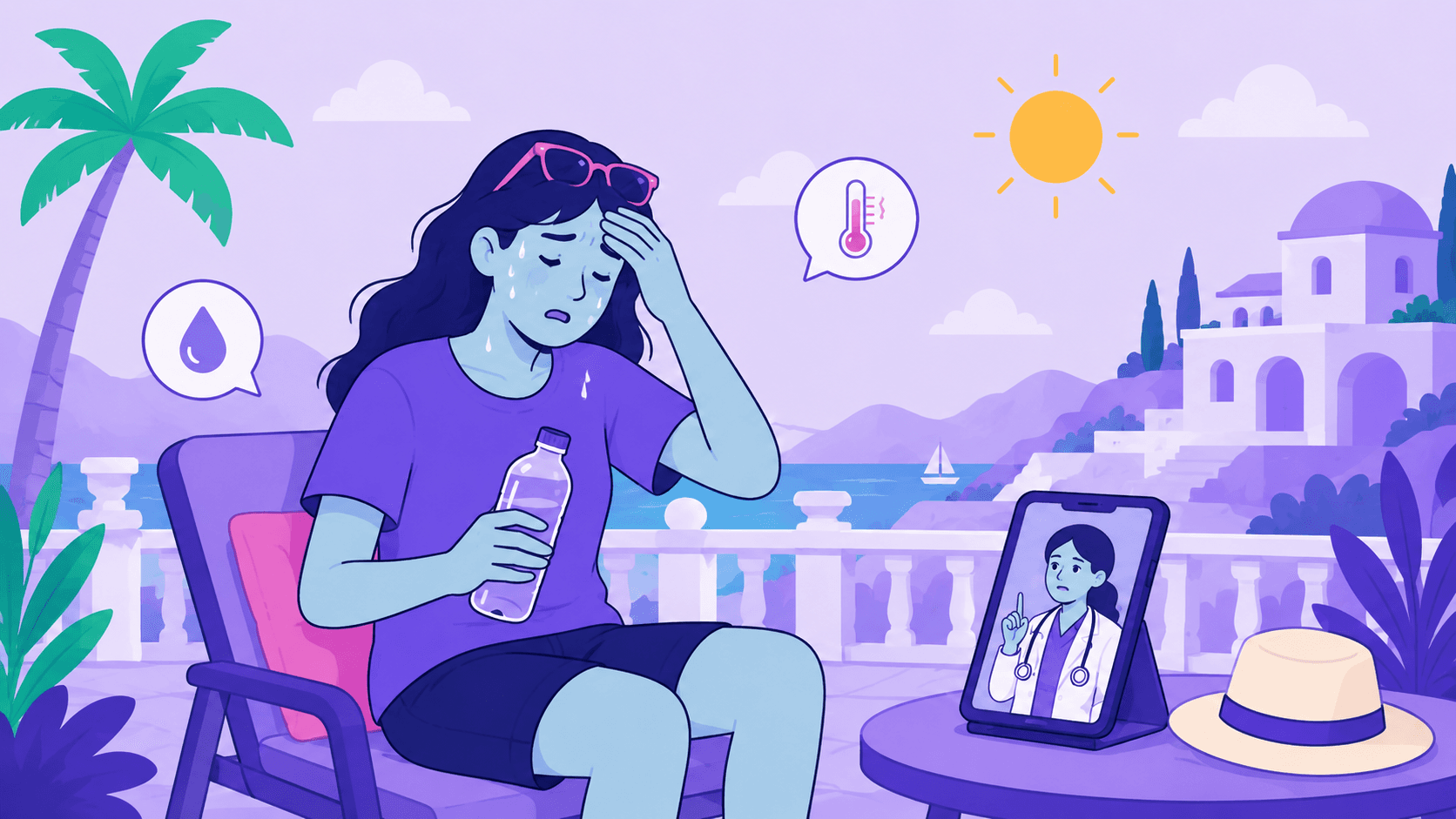
Most heat illness on holiday is heat exhaustion and settles with shade, rest and salty fluids. The part worth knowing is the line where it stops being that.
The short answer
If you feel weak, dizzy, sick or headachy after time in the heat, CDC guidance says most cases are heat exhaustion and are treated by lying down in the shade or somewhere cool, resting, and drinking water or fluids with some salt and sugar; people usually recover within hours. Heat stroke is different and is a medical emergency: a very high body temperature with confusion, loss of coordination, seizures or collapse, and skin that feels hot to the touch. If that is what you are seeing, start cooling the person immediately and call the local emergency number; do not wait for a consultation of any kind.
Worth knowing
- Heat exhaustion: weakness, headache, dizziness, nausea, sometimes irritability or confusion; temperature normal or mildly raised. Shade, lie down, fluids with salt and sugar. Usually better within hours.
- Heat stroke: markedly high temperature plus marked mental change (delirium, convulsions, coma). A medical emergency. Start cooling first, call for help, do not delay one for the other.
- Drinking too much plain water during long exertion can cause low sodium, which looks like heat exhaustion but does not improve with water. Drink to thirst; eat salty snacks on long days.
- Dehydration is the biggest avoidable risk factor. Heart disease, diabetes, kidney disease, some medicines, very young or old age, and not being acclimatised raise the risk.
- A video consultation is one way to get a doctor's view on which of these you are looking at; it cannot cool someone down or treat heat stroke, which CDC describes as a medical emergency for emergency services.
In this guide
Why this happens to travellers in particular
The CDC chapter this article is based on makes a point that is easy to miss: heat illness is most often seen in workers, soldiers and athletes, but travellers get it because many of the most popular destinations are hot, and because people arrive from cooler climates, unfit and not acclimatised, and then do more than they would at home. Sitting on a beach or doing a short walking tour carries minimal risk. Hiking, cycling or a long day on foot in the heat does not.
Two things raise the risk more than anything else. The first is dehydration, which CDC calls the most important predisposing factor apart from the weather and the effort itself. The second is acclimatisation: the body adapts to heat over roughly ten days of daily exercise in it, and visitors in their first week have not had that time. CDC also lists the conditions that limit heat tolerance: cardiovascular disease, diabetes, kidney disease, certain medications, skin conditions or scarring that limit sweating, very young or old age, high body mass and a current infection.
Heat exhaustion: what it looks like and what to do
According to CDC, most people who feel unwell during or after exertion in the heat, or who cannot keep going, have heat exhaustion. The presumed cause is loss of fluid and salts. Mental changes such as irritability, confusion or irrational behaviour can be present; body temperature can be normal or mildly raised. It can also build over several days in someone not used to the heat, and is often mistaken for a summer flu: weakness, fatigue, headache, dizziness, loss of appetite, nausea, vomiting and diarrhoea.
CDC's treatment is simple and works: lie down in the shade or somewhere cool, rest, and drink water or fluids that contain some glucose and salt. Most people cool spontaneously and recover within hours. The chapter gives a recipe travellers can make themselves: a quarter to half a teaspoon of table salt in a litre of water, with a few teaspoons of sugar or some orange or lemon juice for taste. Commercial sports drinks work too, and so does plain water with salty snacks.
Heat stroke: the emergency
Heat stroke is the one form of heat illness where the body has stopped being able to bring its own temperature down. CDC describes it as a medical emergency requiring aggressive cooling and hospital care, because uncontrolled high temperature and circulatory collapse damage the brain, kidneys, liver and heart. It can come on acutely in a fit person exercising hard in the heat, usually still sweating heavily, or gradually over days in someone chronically ill who has simply been too hot.
The early symptoms overlap with heat exhaustion: confusion or a change in personality, loss of coordination, dizziness, headache, nausea. The difference is progression and degree. CDC's field definition is a body temperature of 41°C or more with marked mental change such as delirium, convulsions or coma; and it adds that even without a thermometer, someone with heat stroke will feel hot to the touch. Many complications happen in the first 24 to 48 hours, which is why hospital is the destination.
The trap: drinking too much water
CDC gives this its own section because it catches people who are trying to do the right thing. Over long exertion, drinking large volumes of plain water can push blood sodium too low. The early symptoms look exactly like heat exhaustion: loss of appetite, nausea, vomiting, headache, weakness, lethargy. The clues CDC gives are that mental changes persist or appear without a raised temperature, that major symptoms come on late or even after stopping, and that the person has been drinking a lot of water. The chapter calls the old advice that you cannot drink too much outdated and dangerous.
The prevention is to drink enough to relieve thirst, not more; and on long days in the heat, six hours or more, to take in salt, which CDC says is best done with food: salty snacks such as crackers, pretzels or trail mix rather than salt tablets, which often cause nausea. Most sports drinks do not contain enough sodium on their own for this.
Preventing it in the first place
- Lightweight, loose, light-coloured clothing that lets air circulate, and a wide-brimmed hat, which CDC says markedly reduces radiant heat.
- Drink during exertion; thirst alone is not a reliable guide for mild dehydration, but forcing water on someone who is not thirsty raises the risk of low sodium. For short or moderate effort plain water is as good as electrolyte drinks.
- Salt from food on long days, not tablets. Checking urine colour and volume is most accurate in the morning.
- Do less in the first week. CDC advises limiting the intensity and length of exercise during the first week of travel and avoiding strenuous activity in the hottest part of the day, which is what local people do.
You are already there: what this means in practice
Everything above is the CDC chapter. This section is ours. If you are reading this in a hotel room in Egypt, Morocco, Malta or the Dominican Republic in summer, the practical points are these. First, the summer flu pattern is common: two or three days of feeling rotten, headachy, off your food, a bit of diarrhoea, in someone who has been walking in 35 degree heat. Shade, rest and salty fluids are what CDC describes for heat exhaustion, and they are also a useful test: if you are better in hours, that was probably it.
Second, the countries we write about change the next step. In Egypt, TravelHealthPro lists heat among the risks for everyone and advises a priority on hydration and shade in desert areas; hotels will offer a doctor to your room, and FCDO's caution about that is on our Egypt guide. In Morocco, pharmacies are open round the clock in every city, which matters for rehydration salts at night; the route from there is on our Morocco guide. In Malta, you can see a private GP at most pharmacies, and 112 reaches an ambulance: see our Malta guide. In the Dominican Republic, tap water is not drinkable, so rehydrate with bottled water; resorts send doctors and the private hospitals are expensive, which is covered on our Dominican Republic guide. In France, 15 reaches the SAMU for a medical emergency such as heat stroke, and the pharmacie de garde, the duty pharmacy, covers nights, Sundays and public holidays; see our France guide.
What a video doctor can and cannot do about this
Honestly stated. A video consultation is one option for the grey zone: you are unwell in the heat, you cannot tell whether this is a day in the shade or something more, and you would like a clinician to look at you and ask the questions that matter. A doctor can see how you look and talk, ask how much you have drunk and whether you are passing urine, check for the mental changes CDC describes, tell you whether to rest and rehydrate or to be seen, and say what to watch for over the next hours. For an older traveller, a child, or someone with one of the conditions CDC lists, that judgement is worth more.
A video consultation cannot take a temperature, cannot cool anyone down, and cannot treat heat stroke; nothing on this page should delay emergency care if that is what the situation needs. If the person is confused, has collapsed, is having a seizure, or feels hot to the touch, CDC's guidance is emergency services and cooling without delay; a video consultation is not a substitute for that, and we would rather say so here than have anyone find out later.
Common questions
What is the difference between heat exhaustion and heat stroke?
According to CDC, heat exhaustion is weakness, headache, dizziness and nausea, sometimes with irritability or mild confusion, and a normal or mildly raised temperature; it is treated with shade, rest and salty fluids and settles within hours. Heat stroke is a medical emergency: a markedly raised temperature with marked mental change such as delirium, convulsions or coma, in someone who feels hot to the touch. The distinction is degree and progression; if in doubt, cool and call.
What should I drink if I have heat exhaustion?
CDC says water or fluids containing some glucose and salt. A home-made version is a quarter to half a teaspoon of table salt in a litre of water with a little sugar or citrus juice for taste. Sports drinks work, and so does plain water with a salty snack. Rest in the shade while you drink.
Can you drink too much water in the heat?
Yes. CDC warns that drinking large volumes of plain water during long exertion can lower blood sodium, with symptoms that mimic heat exhaustion but do not improve with more water, and can progress to confusion and seizures. Drink to thirst and eat salty food on long hot days.
How do I cool someone with suspected heat stroke?
Call the emergency number and cool at the same time. CDC lists, in increasing order of effectiveness: shade; remove excess clothing, spray or sponge tepid water and fan, or cold wet towels plus fanning, with ice or cold packs on the neck, armpits and groin; and immersion in cool or cold water, holding the person throughout, or immersing forearms and hands if full immersion is not possible. Give fluids only to someone awake enough to drink.
Who is most at risk of heat illness on holiday?
CDC names people who are dehydrated, not acclimatised or not physically fit, very young or old, with a high body mass, with a current infection, or with cardiovascular disease, diabetes, kidney disease, certain medications, or skin conditions that limit sweating. People doing strenuous activity in the heat during their first week abroad are at higher risk than people on a beach.
Can a video doctor help with heat exhaustion?
For the grey zone it is one option: a doctor can assess how you look and sound, ask about fluids and urine, check for the mental changes CDC describes, and give a view on whether to rest and rehydrate or to be seen. A video doctor cannot take a temperature, cool anyone down or treat heat stroke; suspected heat stroke is, in CDC's terms, a medical emergency, which is a matter for emergency services rather than a consultation.
Is this medical advice?
No. It is general information adapted from a public-domain CDC chapter, with the chapter and its authors named in the box at the top. It has been reviewed by a doctor for medical accuracy, named at the end of the article, but it does not replace a consultation with a doctor about your own situation.
Sources
- Heat and Cold Illness in TravelersCDC Yellow Book 2026, Centers for Disease Control and PreventionAll clinical content: who is at risk and why (destinations, acclimatisation, fitness, dehydration as the most important predisposing factor, the listed conditions and medications); the description of heat exhaustion including possible mental changes, normal or mildly raised temperature, the summer flu presentation and its treatment by supine rest in a cool place and fluids with glucose and salt with recovery within hours; the home-made salt solution recipe; the heat stroke definition (temperature of 41°C or more with marked mental change; hot to the touch), its status as a medical emergency, the field cooling measures in order of effectiveness, and the complications in the first 24 to 48 hours; exercise-induced hyponatremia, its presentation and prevention by drinking to thirst and salt from food; and the prevention advice on clothing, fluids, salt, acclimatisation and limiting exertion in the first week.
- Egypt: country informationTravelHealthPro (NaTHNaC)Heat listed as a risk for all travellers in Egypt, with a priority on hydration and shade in desert areas.
- Morocco travel advice: HealthForeign, Commonwealth and Development OfficeThat pharmacies are open 24 hours in every city and district in Morocco.
- Malta travel advice: HealthForeign, Commonwealth and Development OfficeThat a private GP can be seen at most pharmacies in Malta and that 112 reaches an ambulance.
- Les numéros utiles nationauxMa Sécurité, Ministère de l'IntérieurThat 15 reaches the SAMU, France's emergency medical service.
- Pharmacies de garde de nuits, dimanches et jours fériésAgence régionale de santé Nouvelle-AquitaineThat the French duty-pharmacy rota, the pharmacie de garde, covers nights, Sundays and public holidays.
Keep reading
 SymptomsFood poisoning on holiday: what to do firstThe first few hours, what actually helps, and the symptoms that mean it is time to involve a doctor.
 Symptoms5 common travel illnesses a video doctor can help withNot every travel illness needs a clinic. Five complaints an English-speaking doctor can assess by video, and the signs that mean you should be seen in person.
 Getting careHow to see a doctor online while you are abroadSeeing a doctor by video is one of five realistic options. What each one costs you in time, and how to pick without losing the afternoon.