
Travel health
Stung at the Beach? Jellyfish and Sea Creature Injuries: First Aid That Works
Most stings at the beach are painful and settle. The useful knowledge is what to rinse with, what never to rinse with, and which symptoms mean the beach day is over.
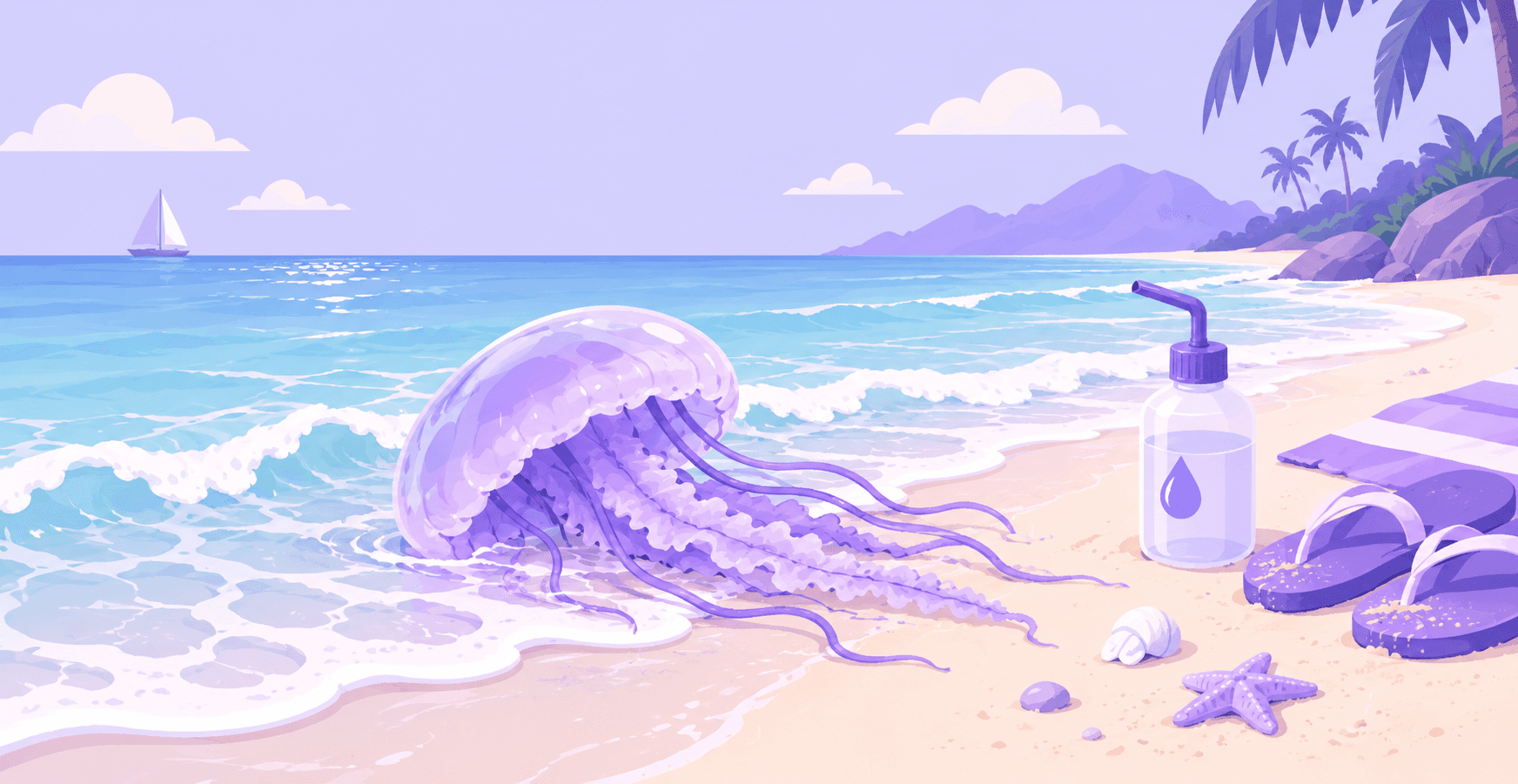
The short answer
For most jellyfish and similar stings, CDC guidance is: get any clinging tentacles off as soon as possible by washing with plenty of seawater, or lift them off with tweezers or the edge of a plastic card, and do not rinse with fresh water, which can fire more stinging cells and make it worse. Beyond that, first aid varies by species and location, so follow local health or emergency guidance. Get emergency help immediately if the person stung develops chest symptoms, severe spreading pain, breathing difficulty, confusion or collapse, and for any sting in tropical Indo-Pacific waters where dangerous box jellyfish occur, do not wait to see how it develops.
Worth knowing
- Tentacles off fast: copious seawater, tweezers, or the edge of a plastic card. Fresh water is the classic mistake. CDC says it can trigger more stinging cells firing.
- Vinegar depends on where you are: CDC says it may help for species in tropical Indo-Pacific waters but can make stings from some species in more temperate waters worse. Urine and alcohol are not recommended anywhere.
- Hot water, about 45°C for around 20 minutes, is the chapter's first aid for venomous fish spines (lionfish, stonefish, stingray, sea urchin) and may help for some jellyfish venoms too; local guidance on temperature and time may differ, and is the one to follow.
- Sea urchin spines are brittle, break off in the skin, and retained fragments cause inflammation and infection. Puncture wounds in seawater sometimes need a tetanus booster, and CDC notes some need antibiotics, a reason to have a doctor look.
- Lionfish and stonefish, once an Indo-Pacific problem, have reached the Mediterranean. A stonefish sting causes severe pain and can cause life-threatening illness: CDC's advice is immediate medical attention.
In this guide
What actually stings you at the beach
The CDC chapter groups the beach stingers under Cnidaria: jellyfish, sea anemones, corals and hydroids, which include fire coral and the Portuguese man o' war. All of them carry stinging structures called nematocysts on their tentacles, which pierce the skin and inject venom. The reassuring baseline the chapter gives: many of these stings cause a painful, itchy rash but are not typically associated with severe illness. Two beach classics get a mention, seabather's eruption, a rash from tiny larvae trapped under a swimsuit, and fire coral, a frequent cause of stings among divers in the Caribbean.
Jellyfish, the chapter notes, are encountered at beaches worldwide, which matches what any Mediterranean summer looks like. Most encounters end with a sore, striped welt and a ruined hour, not a hospital.
First aid: the seawater rule
The chapter's first-aid sequence for these stings is short. If tentacles are still on the skin, remove them as soon as possible by washing with copious amounts of seawater; they can also be lifted off with forceps or the edge of a plastic card, a bank card does the job. The step people get wrong is the rinse: fresh water can stimulate remaining nematocysts to discharge, making the sting worse, and CDC says to avoid it. The same goes for the folk remedies: urine and alcohol are explicitly not recommended.
Vinegar is more interesting, because the honest answer is: it depends where you are swimming. CDC says vinegar may prevent further stinging-cell discharge in certain species found in tropical Indo-Pacific waters, but for some species in more temperate waters it can increase discharge instead. So vinegar is a reasonable first aid to consider in the tropical Indo-Pacific. The right first aid depends on the species and on where you are swimming, and no single set of steps fits every sea, so local health or emergency guidance is the deciding rule: ask the lifeguard, the local emergency service or a local doctor what to use. Rinsing with seawater rather than fresh water, and not touching tentacles or spines with bare hands, are the parts every source agrees on.
The stings that are emergencies
A small number of species change the rules entirely, and the chapter is blunt about them. The Australian box jellyfish, found along northern Australia and in the waters of Malaysia and New Guinea, can cause abnormal heart rhythms and cardiac arrest; effects can occur rapidly, and CDC's advice is to seek immediate medical attention without delay; there is an antivenom, and the race is to reach care. The Irukandji jellyfish of northern Australia causes a syndrome that starts deceptively mild and then builds: waves of muscle spasms, sweating, racing heart, dangerously high blood pressure and a described sense of doom, typically needing urgent hospital treatment. The Portuguese man o' war (found across the Atlantic, Pacific and Indian Oceans, including waters our readers swim in, is not a true jellyfish but has been reported to cause an Irukandji-like syndrome.
Spines: fish, rays and sea urchins
The other family of beach injuries is puncture, not brush. Lionfish are native to the Indian and Pacific Oceans but, as the chapter records, have spread into the Caribbean and the Mediterranean; their spines cause painful stings with redness and swelling, sometimes nausea, weakness and sweating. Stonefish (camouflaged, easy to step on, and now also spotted in the Mediterranean) are more serious: severe pain, rapidly spreading swelling, and the possibility of life-threatening illness, for which CDC advises immediate medical attention. Stingray injuries usually happen when someone steps on the animal; the stinger can break off and stay embedded, and the wound can become infected.
Sea urchins are the everyday version, and anyone who has walked a rocky Mediterranean shore knows them. Their spines cause intense burning pain, and the practical problem the chapter flags is that the spines are brittle: they crumble, fragments stay in, and retained spines cause inflammation, infection and scarring. Medical attention may be needed just to get them out. Two more chapter points worth knowing: hot water immersion helps limit the venom's effects, and travellers who are not up to date with tetanus vaccination may need a booster after marine puncture wounds, with antibiotics sometimes needed on top.
You are already there: what this means in practice
Everything above is the CDC chapter. This section is ours. If you are reading this on a beach day in Malta, Portugal or the Dominican Republic, the practical points are these. First, the seawater rule is the one to remember before anything else, the instinct to rinse a sting under the beach shower tap is exactly the wrong one. Second, the Mediterranean is not the sting-free sea it was: the chapter's note that lionfish and stonefish have arrived there is worth taking seriously when you step between rocks. Swim shoes are cheap.
Third, the countries we write about change the next step. In Malta you can ask to see a private GP at most pharmacies, and 112 reaches an ambulance, the details are on our Malta guide. In Portugal, SNS 24 can tell you where to go, and our Portugal guide covers how the pieces fit. In the Dominican Republic, resort doctors and private hospitals are the route and they are expensive; our Dominican Republic guide sets out what to expect before you agree to anything.
What a video doctor can and cannot do about this
For the ordinary sting, a jellyfish welt that is sore but the person is otherwise fine, a sea urchin foot from yesterday that looks angrier today, a video consultation is a reasonable next step: a doctor can look at the site, ask the questions that separate a local reaction from something spreading, advise on whether the first aid you did was the right one for the species and the sea you were in, and tell you whether the wound needs someone to remove spines, a tetanus booster or antibiotic cover, which are exactly the possibilities the chapter raises for marine puncture wounds.
What a video doctor cannot do is treat the emergencies: box jellyfish and Irukandji-type reactions, stonefish stings, chest symptoms or collapse are for the local emergency number, and a consultation should never delay that call. A doctor also cannot pull embedded spines out over video, but can tell you whether that trip to a clinic is actually needed, which on holiday is often the whole question.
Common questions
Should I rinse a jellyfish sting with fresh water?
No. CDC says rinsing with fresh water can stimulate more stinging cells to discharge and worsen the sting. Use plenty of seawater to wash clinging tentacles off, or lift them away with tweezers or the edge of a plastic card.
Does vinegar help a jellyfish sting?
It depends on the species and the sea. CDC says vinegar may prevent further stinging-cell discharge for certain species in tropical Indo-Pacific waters, but may increase discharge for some species in more temperate waters. So it is a reasonable first aid to consider in the tropical Indo-Pacific. Elsewhere, first aid depends on the species and the location, so follow local health or emergency guidance on what to use. Urine and alcohol are not recommended anywhere.
What do I do about a sea urchin spine in my foot?
Hot water immersion helps limit the venom's effects; recommended temperatures and times vary between countries' guidance, so follow local medical advice on how to do it. The spines are brittle and often break; retained fragments cause inflammation and infection, and CDC notes medical attention may be needed to remove them. Marine puncture wounds can also call for a tetanus booster and sometimes antibiotics, so a wound that stays painful, or a vaccination status you are unsure of, is worth a doctor's opinion.
When is a sting an emergency?
Severe or spreading pain, chest symptoms, difficulty breathing, waves of muscle spasms, confusion or collapse: call the local emergency number. CDC describes box jellyfish stings as capable of causing cardiac arrest rapidly, and Irukandji syndrome as starting mild and becoming dangerous; in tropical Indo-Pacific waters, treat significant stings as urgent rather than waiting to see.
Are there dangerous stinging fish in the Mediterranean?
Yes, more than there used to be. CDC records that lionfish have spread into the Mediterranean and that stonefish have been spotted there too. Stonefish stings cause severe pain and can cause life-threatening illness; CDC advises immediate medical attention. Watching where you step on rocky bottoms, and wearing swim shoes, is the practical prevention.
Can a video doctor help with a sting?
For the non-emergency ones, yes: a doctor can look at the sting, judge whether it is a local reaction or something more, advise on the right first aid for where you are, and tell you whether the wound needs in-person care for spine removal, a tetanus booster or antibiotics. Emergencies, box jellyfish territory, stonefish stings, breathing trouble, collapse, are for emergency services, not a consultation.
Is this medical advice?
No. It is general information adapted from a public-domain CDC chapter, with the chapter and its authors named in the box at the top. It has been reviewed by a doctor for medical accuracy, named at the end of the article, but it does not replace a consultation with a doctor about your own situation.
Sources
- Jellyfish and other sea creature stingsNHSThat stings should be rinsed with seawater, not fresh water, and that tentacles or spines should not be touched with bare hands.
- Poisonings, Envenomations, and Toxic Exposures During TravelCDC Yellow Book 2026, Centers for Disease Control and PreventionAll clinical content: the Cnidaria overview (nematocysts; most stings painful or itchy but not typically severe; seabather's eruption; fire coral among Caribbean divers; jellyfish worldwide); tentacle removal with copious seawater, forceps or a plastic card edge; avoiding fresh water because it can trigger nematocyst discharge; vinegar's region- and species-dependence; urine and alcohol not recommended; hot water immersion at about 45°C for approximately 20 minutes for some jellyfish venoms and for venomous fish spines; the Australian box jellyfish, Irukandji syndrome and Portuguese man o' war descriptions and their emergency status; lionfish and stonefish ranges including spread to the Mediterranean, their sting effects, and the advice of immediate medical attention for stonefish; stingray injury mechanics and embedded stingers; sea urchin spine brittleness, retained-fragment inflammation and infection, hot water immersion, tetanus boosters and possible antibiotics for marine puncture wounds.
- Malta travel advice: HealthForeign, Commonwealth and Development OfficeThat a private GP can be seen at most pharmacies in Malta and that 112 reaches an ambulance.
Keep reading
 Travel healthBitten or Scratched by an Animal Abroad? What to Do in the First 24 HoursRabies is almost always fatal once symptoms appear, and almost always preventable if you act in the hours after a bite. The order of actions matters more than anything else on this page.
 Travel healthToo Hot on Holiday? Heat Exhaustion, Heat Stroke and What to DoMost heat illness on holiday is heat exhaustion and settles with shade, rest and salty fluids. The part worth knowing is the line where it stops being that.
 Getting careHow to see a doctor online while you are abroadSeeing a doctor by video is one of five realistic options. What each one costs you in time, and how to pick without losing the afternoon.