
Medication
Can you get a prescription online without seeing a doctor?
For a new problem the honest answer is no, and the reason is worth two minutes of your time when you are ill and in a hurry.
The short answer
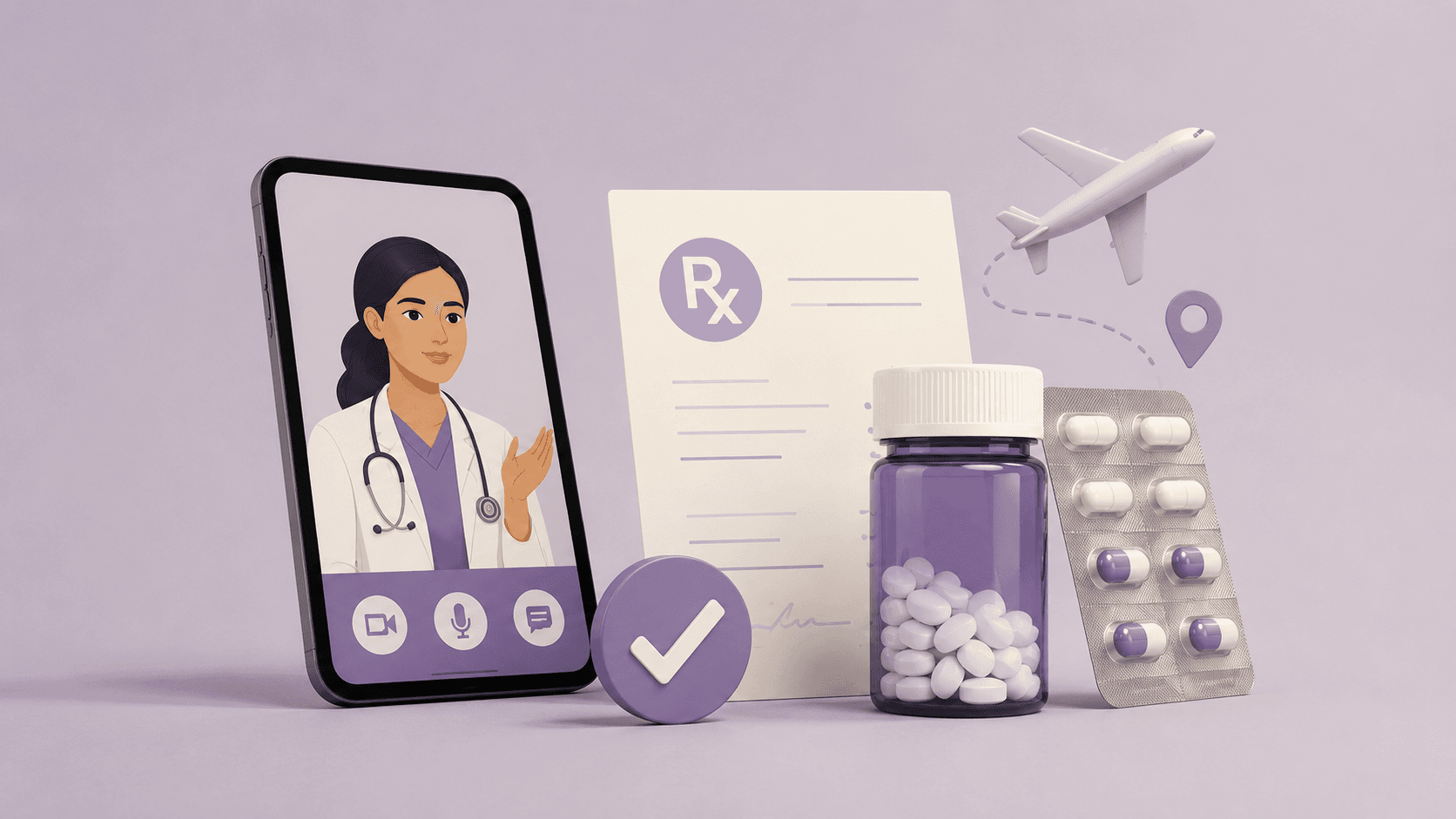
For a new health problem, no. A prescription is the end of a medical process that starts with a diagnosis, and a diagnosis needs a doctor who can ask you follow-up questions rather than read a form you filled in. Questionnaire-based services exist and can be reasonable for low-risk repeat prescriptions in your home country, but they are the wrong tool for an unfamiliar illness in an unfamiliar place. A live consultation is the shortest safe route, including for a refill, and it is usually faster than it sounds.
Worth knowing
- A prescription follows a diagnosis. That order is the whole point, not a formality.
- Symptoms mislead. A cough can be something that needs rest or something that needs treating, and telling them apart is the consultation.
- A static form cannot ask the follow-up question that changes the answer.
- Even for a repeat of a medicine you already take, a short live conversation is the realistic route abroad.
- A video consultation is not an obstacle between you and a prescription. It is the step that makes one possible.
In this guide
You are travelling, you feel rotten, and what you want is the medicine, not the appointment. It is a reasonable thing to want. You have possibly had this exact thing before, you are fairly sure what it is, and the consultation looks like a queue between you and feeling better.
So: can you get a prescription online without actually seeing or speaking to a doctor?
For a new health problem, no. Not because of red tape, but because a prescription written without a diagnosis is a guess with a pharmacy attached. This article explains what the conversation is actually for, and why skipping it goes wrong most often for exactly the people most confident they can skip it.
A prescription follows a diagnosis
A prescription is not a product you add to a basket. It is the end point of a process that has to begin with working out what is wrong, because the medicine is chosen to match the diagnosis and nothing else.
Symptoms are less obvious than they feel from the inside. A simple cough might be a viral infection that needs rest and fluids, or the start of something that needs treating properly. The difference is not in how bad it feels; it is in details a doctor knows to ask about. Getting the wrong prescription is ineffective at best. At worst it settles the symptom enough to hide something that was getting worse underneath.
Live call or online form? The difference matters
Seeing a doctor online covers two quite different things, and the distinction is the practical heart of this question.
Live consultations, where you talk to someone
A real-time conversation with a doctor by video or phone. You speak, they answer, and they follow whatever you have just said. This is how Pomodoc works, and it suits a new problem, a complicated one, or any situation where you have questions of your own.
Questionnaire reviews, where you fill in a form
You complete a static online form, perhaps upload a photograph, and a doctor reads it later. There is no back and forth. This is used for low-risk, non-urgent situations, most often a routine repeat of an ongoing medicine for a settled patient at home.
| Live consultation | Questionnaire review | |
|---|---|---|
| How it works | A real-time conversation | You submit a form and wait for a decision |
| Suits | A new illness, or anything complicated | Low-risk repeats of a stable, known condition |
| Diagnosis | The doctor can follow up on what you say | Rests entirely on the answers you thought to give |
| Abroad | Works, because unfamiliar problems get asked about | Poorly suited to an unknown illness |
Why a form is the wrong tool when you are away
A questionnaire looks like the efficient option. For working out a new illness in an unfamiliar country, it is the wrong instrument, for three reasons that compound each other.
- A form cannot ask the next question. Is the cough dry or productive? Where exactly is the headache? A doctor on a call hears the answer and follows it. A form collects what you already thought to mention.
- It cannot hear you. Tone, breathlessness, how you look while describing it. Doctors use all of it, and none of it survives a text box.
- It does not know where you are. Different food, different insects, different local infections. A generic form is not built to screen for anything specific to the place you happen to be standing in.
The concrete version: you fill in a form describing a urinary tract infection, and in a conversation a doctor hears something that makes them ask about your back and your temperature, and considers a kidney infection instead. Same starting symptoms, different illness, different treatment, and only one of the two routes had a chance of catching it. There is more on where video assessment works and where it does not in what cannot be treated with telemedicine.
What about a repeat of something you already take?
This is the most common reason people go looking for a no-appointment prescription. You have run out, or you left the box at home, and you want the same thing you have taken for years.
It is a fair ask, and it is still not a form-shaped problem. Doctors are reasonably cautious about repeating a prescription for someone they have never met, particularly for medicines that need monitoring, such as those for blood pressure or diabetes. Their caution is not about you; it is about not knowing anything they have not been told.
The practical route is a short video consultation. You can hold the original box up to the camera, explain what happened, and let the doctor make an informed decision about a short local supply. Our guide to prescriptions abroad covers what to carry and what to photograph before you travel, which makes that call considerably shorter.
Getting a prescription abroad with Pomodoc
Pomodoc does not offer prescriptions on demand, and that is a deliberate design rather than a missing feature. What it offers is the step that has to come first: a video consultation with an English-speaking doctor licensed to treat you in the country you are in, who can work out what is actually going on.
Prescriptions when local rules allow. Your doctor may issue one when it’s clinically appropriate and local rules permit. Which is the honest shape of it: the consultation is not a toll gate in front of a prescription, it is the thing that makes a prescription possible and appropriate. Sometimes the answer is a medicine. Sometimes it is that you do not need one, which is also worth knowing. Antibiotics are the clearest example.
In short
- Diagnosis first. A safe prescription follows a diagnosis, not the other way round.
- For anything new, talk to someone. A real-time conversation is what makes a diagnosis possible.
- Forms have a narrow job. Reasonable for low-risk repeats at home, poorly suited to an unknown illness abroad.
- Repeats included. A short call is the realistic way to get a local supply of something you already take.
- The call is not the obstacle. It is the part that gets you a prescription that is right for you.
Common questions
Are the online prescription sites that use questionnaires legitimate?
Some are, for narrow and specific purposes: a low-risk repeat prescription for a settled condition in your home country, where a doctor already knows your history. What they are not built for is diagnosing something new while you are abroad, and that is the situation most people are in when they go looking for one. A static form cannot replace a conversation it cannot have.
But I know I have a UTI. Can I not just get the antibiotic?
Familiar symptoms are a good reason to think you are right and not a reason to skip the check. The same early symptoms can belong to a kidney infection, which is more serious and treated differently, and a short conversation is what separates them. If it is a straightforward case, that call is brief.
I have run out of my blood pressure medication. Can I get a refill without a consultation?
Realistically no. For a medicine that needs monitoring, a doctor needs to speak with you to check your situation is stable before re-prescribing, even for a short emergency supply while travelling. A video consultation is the quickest way through that, not a detour around it.
Is a video consultation a real doctor's appointment?
Yes. It is a formal appointment with a licensed doctor and a confidential one, in the same way a visit to a surgery is. You describe what is happening, the doctor assesses it, and you leave with advice and a plan, which may or may not include a prescription depending on what they find.
Keep reading
 MedicationPrescriptions abroad: what travellers need to knowWhat carries across borders, what does not, and what to do when your medication is 3,000 miles from your bathroom cabinet.
 MedicationCan video consultations prescribe antibiotics?The honest answer is sometimes. Which infections can be judged over video, which cannot, and why a consultation that ends without a prescription has still done its job.
 Getting careWhat is a video consultation?A doctor's appointment that happens over a video call. What to expect, when it helps, and when it is the wrong tool.