
Travel health
Burnt on Day One? Sunburn Abroad: What Helps, What Doesn't
The burn you got by lunchtime shows up at dinner. What settles it, the blister rule most people break, and the two common medicines that made it worse than it should have been.
The short answer
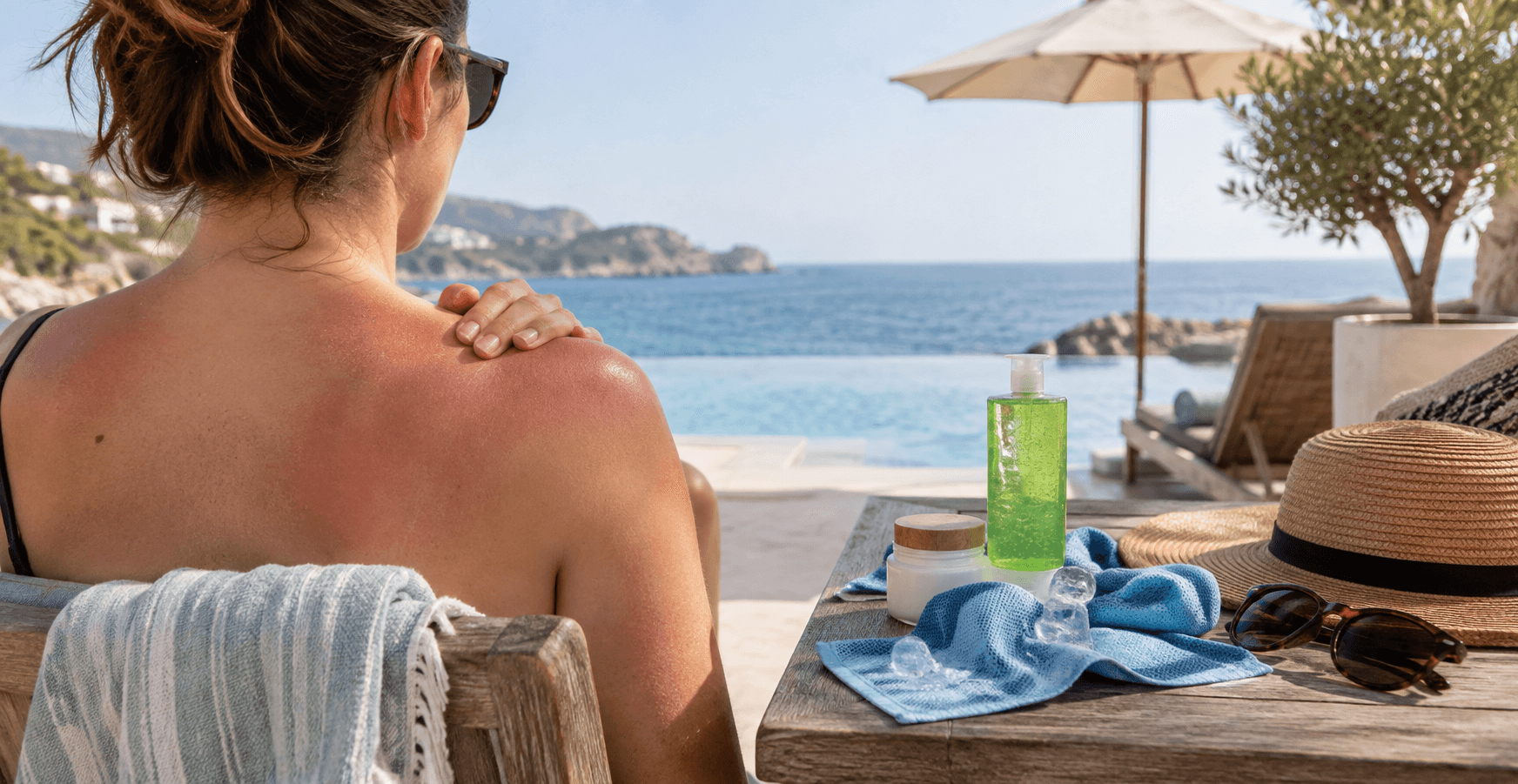
For a sunburn, CDC and NHS guidance agree on the basics: cool the skin with a cool bath, shower or damp towel, use a bland moisturiser or aftersun, rest somewhere cool, drink extra fluids, and take an oral pain reliever if you need one. CDC adds that a mild steroid cream or diclofenac gel can reduce pain and inflammation. Do not pop blisters: NHS says so plainly, and the roof of a blister is a better dressing than anything you can buy. Get medical help for blistered or swollen skin, a high temperature or chills, dizziness or feeling sick, or any sunburn in a baby or young child: NHS treats those as reasons for urgent advice. CDC treats extensive blistering like a thermal burn, sometimes needing fluid replacement.
Worth knowing
- The burn declares itself late: discomfort begins several hours to a day after it happened, which is why people burn badly on day one. Cool water, wet compresses, bland (ideally fridge-cold) emollients, fluids and rest are the CDC-described care.
- Do not pop blisters. NHS says do not pop any blisters, and treats blistered or swollen sunburn as a reason for urgent advice. The blister roof works as a sterile dressing, CDC notes, better than an adhesive bandage.
- Systemic steroids do not help sunburn. CDC states they neither improve symptoms nor speed recovery. A mild topical steroid or diclofenac gel is the chapter's option for pain and inflammation.
- Common medicines make skin burn faster: doxycycline (the malaria-prevention pill many travellers carry) is the classic, and NSAIDs like ibuprofen and naproxen are on CDC's photosensitiser list too.
- Lime juice plus sun is its own injury: phytophotodermatitis, a blistering rash where juice dripped on skin, common where fresh limes meet cocktails. It heals into brown streaks that can last months.
In this guide
Why holiday sunburn is worse than home sunburn
The CDC chapter this article is adapted from starts with the geometry: ultraviolet radiation is stronger at lower latitudes, at higher elevations, and in the middle of the day, and it reflects off water and sand, so a beach holiday closer to the equator delivers more UV per hour than the same hour at home, with the sea and the sand topping it up from below. UVB, the more burning and more carcinogenic band, peaks between 10 a.m. and 4 p.m. The chapter's other timing point explains the classic day-one disaster: people rarely notice a sunburn while it is happening, and the discomfort begins several hours to a day later. By the time it hurts, it is done.
Treating it: what the chapter actually says
Sunburn care in the chapter is supportive, and specific. First-line: cool baths or showers, wet compresses, and a bland topical emollient, with the practical note that refrigerating it before applying it adds relief. Aloe vera, the default holiday remedy, gets a cooler verdict: commonly used, but the studies assessing its benefit are equivocal. For pain and inflammation, the chapter names topical hydrocortisone 1% or diclofenac gel, plus rest in a cool setting, extra fluids and oral pain relievers.
One myth the chapter kills directly: systemic steroids do not improve symptoms or hasten recovery from sunburn. The treatment is skin care, fluids and time.
The medicines that burned you faster
This is the part of the chapter most travellers have never heard, and it is directly relevant to people who prepared properly for their trip. Many medications are photosensitisers: they make skin react to less sun than it normally would. CDC's list includes doxycycline, prescribed to travellers for malaria prevention, along with other tetracyclines to a lesser degree; fluoroquinolone and sulfonamide antibiotics; and everyday NSAIDs, especially ibuprofen, ketoprofen, naproxen and piroxicam. Some diuretics, sulfonylureas, methotrexate and retinoids are on the list too. The chapter even names a specific pattern for the doxycycline crowd: photo-onycholysis, where the nail lifts from the nail bed after intense sun on the drug.
The practical reading: if you are taking doxycycline for malaria prevention and you burned much faster than you expected, the pill is a likely part of the story, which is not a reason to stop it, but a reason to take the prevention section below more seriously, and something worth telling a doctor who is assessing your burn.
The lime juice burn
The chapter gives holiday bartending its own injury. Phytophotodermatitis happens when UVA hits skin carrying photosensitising compounds from certain plants, most famously the juice of Persian, wild or key limes. The scenario the chapter describes is exactly the poolside one: someone squeezes fresh lime over food or a drink, juice drips or spritzes onto their skin, and within a day or two a painful blistering rash appears where it landed. As it heals, it leaves distinctive linear or drop-shaped brown patches that can persist for weeks or months. Perfumes and essential oils containing citrus oils such as bergamot can do the same. The fix is prevention: rinse lime juice off skin before going back into the sun.
Not burning tomorrow: the short version of prevention
- Timing beats products: the chapter's first recommendation is avoiding direct sun between 10 a.m. and 4 p.m., and it notes shade plus sunscreen protects far better than either alone.
- Sunscreen that works: broad-spectrum, SPF 30 or higher, applied at least 15 minutes before going out, about a shot-glass worth for an adult, reapplied every 2 to 4 hours and after swimming or sweating. The commonly missed spots are ears and the tops of feet; lips need a balm actually labelled SPF 30, because lip skin has almost no protective melanin.
- Clothing does the heavy lifting: UPF-rated shirts and swim-shirts (UPF 50 blocks 98% of UV, so the covered skin needs no sunscreen), a hat with a real brim, the chapter is explicit that a baseball cap does not protect ears or neck, and UV 400 sunglasses.
- Children: under 6 months, no sunscreen is approved, shade, clothing and covered strollers instead. Over 6 months, the chapter points to mineral (zinc oxide / titanium dioxide) sunscreens as the gentler choice, and to spraying any spray product onto adult hands first, never at a child's face.
- If you also use insect repellent: sunscreen first, repellent at least 15 minutes later, and skip the combination products. CDC notes DEET can cut a sunscreen's SPF by around 30% and combined use raises absorption concerns.
You are already there: what this means in practice
Everything above is the CDC chapter. This section is ours. The likeliest version of this story on our destination pages is a Northern European traveller on their first or second day in Malta, southern Portugal, Egypt or the Dominican Republic: lower latitude than home, sea and sand reflection, and the burn discovered at dinner. The care is the same everywhere: cool water, emollients, fluids, shade the next day. What changes by country is the next step when it is worse than that. In Malta, a pharmacy-based GP can look at a blistering burn the same day; our Malta guide explains how that works. In Portugal, SNS 24 will route you; see our Portugal guide. In Egypt, hotels offer room-call doctors and FCDO's caution about that route is on our Egypt guide. In the Dominican Republic, private care is the route and it is expensive; our Dominican Republic guide covers what to check before agreeing to treatment.
What a video doctor can and cannot do about this
Sunburn is unusually well suited to a video look: the injury is on the surface. A doctor can see the extent and depth of the burn, distinguish an ordinary burn from a blistering one heading toward the chapter's thermal-burn territory, check whether a medicine you are taking, doxycycline included, is part of the picture, talk through blister care so the roof stays on, and tell you whether this is manage-in-the-room or be-seen-today. For a child with a large burn, that judgement call is often the whole consultation.
What a video doctor cannot do is replace hospital care where the chapter says it may be needed: extensive blistering with fluid loss is treated like a thermal burn, and a burn accompanied by high fever, repeated vomiting or confusion needs in-person assessment. A consultation is the judgement layer, not the treatment for the severe end.
Common questions
Paracetamol or ibuprofen for sunburn?
Either can ease the pain: NHS sunburn advice is to take a painkiller such as paracetamol or ibuprofen, following the leaflet. Three things can tip the choice. Ibuprofen is an anti-inflammatory (an NSAID) and paracetamol is not, but the NHS notes ibuprofen causes more side effects and suggests trying paracetamol first if you can take it. Ibuprofen may not suit you if you have asthma, a stomach ulcer now or in the past, a heart, liver or kidney condition, or have reacted to aspirin or another NSAID. And CDC lists ibuprofen among the medicines that make skin burn more easily, which matters if you are heading back into the sun. A pharmacist can help you choose.
What actually helps a bad sunburn?
The care CDC describes: cool baths or showers, wet compresses, a bland moisturiser (refrigerate it first for extra relief), rest somewhere cool, extra fluids, and oral pain relievers. Hydrocortisone 1% cream or diclofenac gel can reduce pain and inflammation. Aloe vera is popular but the evidence for it is equivocal, and systemic steroids do not help at all.
Should I pop sunburn blisters?
No. NHS says do not pop any blisters, and treats blistered or swollen sunburn as a reason to get urgent advice. Leave the roof of the blister in place: it works as a sterile dressing.
Why did I burn so fast? I never burn at home.
Three multipliers: lower latitude, midday UVB (strongest 10 a.m. to 4 p.m.), and reflection off water and sand. And check your medicines: CDC lists doxycycline, the malaria-prevention pill, as a photosensitiser, along with ibuprofen, naproxen and several antibiotics. On those, skin burns with less sun than it normally needs.
When is a sunburn a reason to see a doctor?
Sooner than most people think. NHS says to get urgent advice for any blistering or swelling, a high temperature or chills, feeling tired, dizzy or sick, a headache or muscle cramps, or any sunburn in a baby or young child. CDC adds that extensive blistering may need hospital care with fluid replacement, managed like a thermal burn, and confusion with a burn needs in-person care. For everything milder, supportive care and time do the work.
What is the rash I got where lime juice touched my skin?
Likely phytophotodermatitis: UVA acting on photosensitising compounds in lime juice causes a painful blistering rash where the juice dripped, appearing within a day or two, healing into brown streaks that can last weeks or months. Citrus oils in perfumes can do the same. Rinse juice off before sun; if a rash is severe or spreading, have a doctor look.
Can a video doctor assess a sunburn?
Yes; it is a visible, surface condition, which suits video well. A doctor can judge extent and severity, advise on blister care, check whether your medications contributed, and tell you whether you need in-person care. What video cannot replace is hospital treatment for extensive blistering burns or burns with serious systemic symptoms.
Is this medical advice?
No. It is general information adapted from a public-domain CDC chapter, with the chapter and its authors named in the box at the top. It has been reviewed by a doctor for medical accuracy, named at the end of the article, but it does not replace a consultation with a doctor about your own situation.
Sources
- Sun Exposure in TravelersCDC Yellow Book 2026, Centers for Disease Control and PreventionAll clinical content: UV risk geometry (latitude, elevation, midday UVB 10 a.m. to 4 p.m., reflection off water, sand and snow); sunburn features including delayed onset by several hours to a day and systemic symptoms (headache, fever, chills, nausea, vomiting, muscle aches); the described care (cool baths or showers, wet compresses, bland emollients, refrigeration for added relief, aloe vera's equivocal evidence, hydrocortisone 1% or diclofenac gel, rest, fluids, oral pain relievers, and that systemic steroids do not improve symptoms or hasten recovery); blister management (no intentional rupture, roof left as a dressing, loose covering) and hospital-level care for extensive blistering treated like thermal burns; the photosensitising-medication list (doxycycline and tetracyclines, fluoroquinolones, sulfonamides, ibuprofen, ketoprofen, naproxen, piroxicam, furosemide, methotrexate, sulfonylureas, thiazides, retinoids) and photo-onycholysis with doxycycline; phytophotodermatitis from lime juice and citrus oils with persistent hyperpigmented streaks; and the prevention set (10 a.m. to 4 p.m. avoidance, shade plus sunscreen superiority, broad-spectrum SPF 30+, one-ounce application 15 minutes before exposure, 2 to 4 hour reapplication, missed areas, SPF 30 lip balm and lips' lack of melanin, UPF clothing and swim-shirts with UPF 50 blocking 98%, three-inch brims versus baseball caps, UV 400 sunglasses, infant and child guidance including mineral filters and spray precautions, and the DEET and sunscreen interaction with sunscreen first and repellent 15 minutes later).
- SunburnNHSThat painkillers such as paracetamol or ibuprofen can be taken for sunburn pain, following the instructions in the leaflet; that sunburn can be cooled with a cool shower, bath or damp towel and soothed with aftersun or an unperfumed moisturiser; not to pop any blisters; and to get an urgent GP appointment or help from NHS 111 for blistering or swelling, a high temperature or chills, feeling tired, dizzy or sick, a headache, muscle cramps, or sunburn in a baby or young child.
- Ibuprofen for adultsNHSThat ibuprofen is a non-steroidal anti-inflammatory drug that relieves pain and reduces inflammation; that it can cause more side effects than paracetamol and paracetamol is worth trying first if you can take it; and that it may not be suitable with a past NSAID or aspirin reaction, a current or past stomach ulcer, asthma, or a heart, liver or kidney condition.
- Egypt: country informationTravelHealthPro (NaTHNaC)Sun exposure and heat listed among risks for travellers to Egypt, with priority on protection and hydration.
Keep reading
 Travel healthToo Hot on Holiday? Heat Exhaustion, Heat Stroke and What to DoMost heat illness on holiday is heat exhaustion and settles with shade, rest and salty fluids. The part worth knowing is the line where it stops being that.
 Travel healthStung at the Beach? Jellyfish and Sea Creature Injuries: First Aid That WorksMost stings at the beach are painful and settle. The useful knowledge is what to rinse with, what never to rinse with, and which symptoms mean the beach day is over.
 Getting careHow to see a doctor online while you are abroadSeeing a doctor by video is one of five realistic options. What each one costs you in time, and how to pick without losing the afternoon.